Please wait a few seconds while we redirect you
to the new and improved House of Annie website at
www.houseofannie.com !

Tuesday, February 09, 2010

Cat’s Eye Fruit (Mata Kuching)

Another of Borneo’s unique tropical fruit, the Mata Kuching (Cat’s Eye Fruit) is a cousin of the Longan (Dragon Eye Fruit).

Mata Kuching – Cat’s Eye Fruit

Yellow Mata Kuching Cats Eye Fruit

On the day we went to the market in Serian, we found this fruit which we had never seen before. It was round, about the diameter of a dime, and covered in tough, bumpy, leathery, yellow skin. We asked the vendor what it was, and she said “mata kuching”.

“Is it good?” we asked. Oh, yes, she replied. She let us peel open a few to taste. The fragrance and taste reminded me exactly of longan (dragon eye fruit). I thought to myself, why not give it a shot? So we came home with a kilogram of these fruit.

The Eye of the Cat

In the Bahasa Malaysia language, “mata” means “eyes” and “kuching” means “cat”. The fruit is called Cat’s Eyes because when you peel off the skin and expose the dark seed under the flesh, it looks like a cat’s eye.

Peeled Mata Kuching

Peeled Mata Kuching Cats Eye Fruit

Mata Kuching trees grow prolifically here in Sarawak and Sabah on Borneo. One of the explanations for how our city of Kuching got its name is that the city started along the banks of the river where many of these mata kuching trees were growing.

According to International Society for Horticultural Science, the mata kuching is actually a close relative of the longan (hence the similar smell and taste). There are 3 varieties of mata kuching fruit which have “warty” skins and a 4th variety which is smooth and most closely resembles the longan.

The yellow-skinned variety has skin which feels very bumpy on the outside, almost like a lychee. This fruit with a large seed pit and very little flesh. When I found out how little meat was on the “bone” of the fruit, I was put off and a little upset at paying so much for so little edible meat. I ended up tossing the rest.

A Second Eye

Our friend Mike recently gave us some mata kuching which he brought back from Sibu, a town about 6 hour’s drive away. These fruit were the same size, but greener in color, and less bumpy.

Mata Kuching from Sibu

cats eye fruit

They also had considerably more meat on them, and were sweeter than the Serian variety.

Peeled Mata Kuching from Sibu

cats eye fruit peeled

These we finished eating in one sitting! ;-)

Aloha, Nate

This post was entered into the Weekend Herb Blogging roundup, hosted this week by Mele Cotte and organized by Haalo of Cook Almost Anything.

Hungry for more exotic fruits? Click below:

Fruits of Serian

Buah Tarap – Borneo’s Unique Tropical Fruit

Rambutans

Brian's Pink Pomelos

Continue Reading: "Cat’s Eye Fruit (Mata Kuching)"...

Saturday, January 23, 2010

Recipe for Banana Nut Bread

What to do with bananas going ripe?

bunches of bananas

Banana bread is one of my favorite things to eat when I’m hungry or when I’m needing a little pick-me-up during the afternoons. I guess as a lover of all things banana, I just enjoy the goodness of the banana flavors and the comforting bite of the tender and moist bread. To me, I’ve always thought that banana bread isn’t really a bread at all, it’s more of a cake (just like the Dutch apple cake that we posted recently). Can anyone tell me why they’re called breads?

And of course, when you add walnuts to the mix, that just adds another layer of texture to it. I almost always add more nuts to my batter than what is called for. For some reason, walnuts just go really well with bananas. I read somewhere that toasting the nuts also prevents the nuts from turning black in the baked goods. So, I toast the walnuts before adding them in to the batter.

Irresistible

Now, most recipes that I’ve seen out there call for just a little butter and a small quantity of ripe bananas. But I just can’t resist adding more butter and really upping the quantity of ripe bananas. Maybe that’s why my banana bread turns out to have a more cake-like texture. Whatever it is, I have found that upping these ingredients don’t seem to affect the bread too much and it’s still wonderfully moist and delicious. The extra bananas seem to help to perfume the bread with that heady banana fragrance that makes you want to snatch it out of the oven as it is baking up!

The one key thing to any banana recipe (except banana cream pie where you want the bananas nice and pretty looking) is that you really, really need to wait till your bananas are overripe. Being in Malaysia, this happens more quickly than you think. I find that after just two days, my fresh bananas have become super ripe so I’ve been baking banana bread more often than I’d like. Thankfully, I have friends and neighbors to share this with. If you haven’t gotten a banana bread from me, never fear, you probably will in no time at all (as long as you live close by).

If you find yourself overrun with ripe bananas and cannot keep up, another trick is to peel the bananas, stick them in a freezer bag and freeze them. Then the next time you feel like baking banana bread, you won’t have to wait for your bananas to ripen. Just thaw the bag and mash the bananas and you’re good to go.

Alright, so here is my recipe for banana bread. Do give it a try the next time you have loads of overripe bananas sitting on your kitchen counter! Or if you just love banana bread, buy some bananas and let them get ripe on the counter (or try bargaining with your grocery store manager for the bananas that are already overripe in the store!).

Banana Nut Bread Recipe

Ingredients:

2 cups (10 oz) all-purpose flour
1 tsp baking soda
1/2 tsp salt
1 cup sugar
1 cup (8 oz) butter
2 eggs
2 cups mashed ripe bananas (really, I find it’s ok to have a bit more or less, I just tend to eyeball depending on how many ripe bananas I have)
1/4 cup milk
1 tsp vanilla essence
1/2 cup chopped walnuts (or other nuts), more if you like it nuttier

banana nut bread ingredients

Method:

1. Preheat oven to 350 F (180 C).
2. Cream sugar and butter till well mixed.
3. Add eggs and bananas. Blend well.

mixing banana bread batter

4. Add milk and vanilla essence and mix till well incorporated.
5. Stir in nuts and dry ingredients (you can sift the dry ingredients if you want but I normally don’t bother) and mix well.

adding walnuts to banana nut bread batter

6. Pour into loaf pan and bake for about 60-70 minutes till tester comes out clean. One trick I do is to use two slightly smaller loaf pans and bake up thinner loaves when I’m in a hurry (ie. can’t wait to take a bite into the warm, yummy bread). This way, the baking time will only be about 30-40 minutes.

baked banana nut breads

Enjoy!

Cheers, Annie

This post was entered into the January edition of Sugar High Fridays, created by Jennifer, the Domestic Goddess and hosted by A Merrier World.


Hungry for more baked banana goodness? Click below:

Aunty Marlene's Banana Muffins Recipe

Recipe for Banana Cream Pie

Banana Nut Muffins Recipe on Rasa Malaysia

Ultimate Banana Bread Recipe Collection on Not Quite Nigella

Continue Reading: "Recipe for Banana Nut Bread"...

Tuesday, January 19, 2010

Buah Tarap – Borneo’s Unique Tropical Fruit

It smells like a burning tire but tastes like the sweetest custard apple.

opening a buah tarap

We are really happy to be living here in Sarawak. Time and again, the kindness and the generosity of the people here simply blow us away. Last month, when we invited our friend Paul and his family over for a big, home-cooked Japanese meal of miso soup, niku-jaga, kabocha no nimono, and sesame salad with chicken, they brought over a couple of these unique fruits called “buah tarap” to eat for dessert.

Borneo Native

Buah tarap (also called Marang) is a fruit that is native to Borneo. They are related to breadfruit and jackfruit. I have seen it in season in December, around the same time as the durian season. The fruits are about the same size and shape as a durian. However, the spines of the tarap are soft and rubbery compared to the hard, thorny spines of the durian.

The fruit does not fall when it ripens – usually they are harvested green and allowed to ripen off the tree. As they ripen, the outer rind turns from green to brownish-yellow. It also gives off a distinctive odor, that I liken to the smell of burning tires. Maybe that’s why buah tarap’s scientific name is Artocarpus odoratissimus!

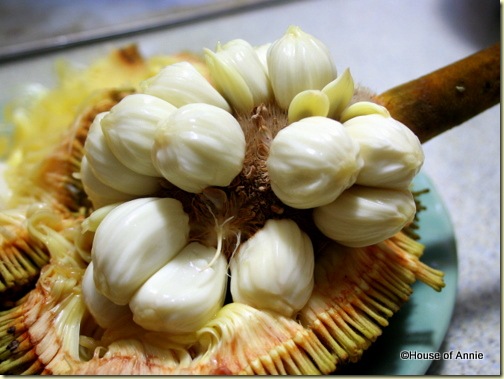
Contrary to the difficulties in opening fruits like durian or jackfruit, the buah tarap is very easy to open. As the above picture shows, you simply pry apart the rind, which cleanly separates from the inner fruit. The fruit arils are all nestled inside, attached loosely to the stem.

opened buah tarap

These arils are similar in shape to a jackfruit, but they are not sticky nor slippery. The flesh is a creamy white. You could pick them off the stem – they come off with a slight twist/tug – or you can use a fork to gently lift them off. Once you have one, just pop it in your mouth!

buah tarap fruit aril

The fruit itself is soft and creamy. It tastes like the sweetest custard apple or soursop, but it is smooth, not grainy. And just a bare hint of tartness. The flesh is easily separated from the small seed with your teeth. The seeds (or biji) themselves are edible. You just wash them, dry them overnight, then roast them in the oven. They taste like roasted nuts!

buah tarap fruit 2

The fruits are so yummy and so easy to eat, one person could devour it alone in no time. After our party finished off one buah tarap for dessert, Paul left us with one more green fruit to enjoy in the following days. And he had also brought a big bag of buah tampoi that we all also enjoyed. See? Talk about generosity!

buah tarap fruit

The only downside was having to endure the burning tire smell in the house for a few days while the fruit ripened. But we got over it. ;-)

Aloha, Nate

I am entering this post into the 217th edition of Weekend Herb Blogging, hosted by Anna's Cool Finds, and administered by Haalo.

Hungry for more interesting fruits? Click below:

Fruits of Serian

Rambutans

Mangosteens

Pomelos

Continue Reading: "Buah Tarap – Borneo’s Unique Tropical Fruit"...

Thursday, January 07, 2010

Cheese Pie with Peaches

A simple dessert that will satisfy your cheese cake cravings without going overboard with the calories. And making it is as easy as, well, pie!

Cheese Pie with Peaches

cheese pie with peaches
This isn’t a savory cheese pie like a spinach or a tomato cheese pie. It’s a dessert recipe I got from my Third Aunt a long time ago. It’s really very similar to a cheese cake except that the base is made using crushed Marie biscuits. You also don’t use as much cream cheese (only one 250g block) as most cheese cake recipes. And I would say it’s not as rich as a New York-style cheese cake.
Unlike some previous cheese cake attempts, I have never had any cracking issues when baking this cheese pie. I’ve even over-baked it a few times and it still comes out pretty good. So for those who don’t like the hassle of a bain marie (water bath) or if you like cheese cakes but would rather have a lighter version, this is the recipe for you.

Tips and Techniques

To make the cheese pie crust, you need to crush some Marie biscuits (if you cannot find Marie biscuits, cream crackers will work just as well, I imagine). Now normally, I would use a food processor to just blend them up. However, now that I’m in Malaysia, I haven’t had a chance to get myself a food processor. Thankfully, the mortar and pestle has been seriously handy in all my food preps. And even though it’s a lot more humbug, it does the job just as well.
marie biscuitscrushing marie biscuits
Besides the cream cheese filling, my aunt used to always add canned peaches to the pie. You could use peaches, apricots, mandarin oranges, cherries or even sliced pineapple. And once the pie is baked, you can also decorate the top with more canned fruit. Of course, if you want to use fresh fruit to decorate the top of your pie, you definitely can. I don’t recommend using fresh fruit in the filling part as the fresh fruit will cause the filling to become too watery.

Cream Cheese Pie with Peaches

Ingredients:
For the crust:
150g Marie biscuits, finely ground
62g butter, melted

For the filling:
250g cream cheese, at room temperature
4 oz sugar
1 egg
1/4 tsp vanilla essence
2 tsp gelatin dissolved in 2 Tbsp hot water
1 can sliced peaches (you may have leftovers)

Method:
1. Mix ground Marie crackers with melted butter evenly. Press into a 9 inch pan and up the sides. Refrigerate for at least 1-2 hours.
marie biscuits pie crust
2. Preheat oven to 350 F (180 C).
3. Beat cream cheese with sugar until well mixed.
4. Add egg and vanilla and mix till incorporated.

cheese pie filling

5. Add in the dissolved gelatine.
6. Arrange peaches on the crust. Pour cream cheese mixture over the peaches.

peach slices in cheese piepouring cheese pie filling
7. Bake pie for about 20-25 minutes until just brown on the edges of the pie (mine was just a little overbaked).
8. Cool the pie and then decorate with more fruit if desired.

baked cheese pie with peaches
Enjoy!
Cheers, Annie

Hungry for more desserts? Click below:

Easy Green Tea Tiramisu Recipe
Strawberry Shortcake Recipe
Pavlova Recipe
Es Teler - A Cool Indonesian Dessert
Honeydew Sago Dessert Recipe: A Refreshing Summer Treat!

Continue Reading: "Cheese Pie with Peaches"...

Monday, January 04, 2010

Rambutans, plus a Grow Your Own Announcement

Ew, it’s a hairy lychee!
Bowl of Rambutans
Well, kinda.
Rambutans are tree fruits which are close cousins to the lychee and the longan. Like a lychee, they are ovoid (egg) shaped, about 2 inches long, and have a hard, inedible seed at the center. But instead of the smooth skins of those two other fruits, rambutans have thin, fleshy spines growing out of them. These spines not sharp like a durian, but pliable like a dragonfruit. The spines are more like thick hairs. In fact, the name “rambutan” comes from the Malay word for hair, rambut.

Rambutans are native to Malaysia, and are grown all over Southast Asia as well as other tropical locales. Here in Sarawak, the rambutan trees are at the peak of production in December. When we took our road trip to see the fruits of Serian and beyond, we spied many rambutan trees growing wild by the side of the road, laden with fruit.

Roadside Rambutan Tree

rambutan tree
Over the New Year holiday, we were invited by one of our church friends to her house for dinner. As we were leaving, she stopped and handed us a bag of hand-picked rambutans. She said they were picked from her brother’s tree in Tebekang. They must have been picked quite recently, as the spines had not started to dry out and wither yet.

Fresh-Picked Rambutans

row of rambutans
Rambutans are best eaten fresh. If you don’t store them well, they start to spoil quickly. The good thing is, they’re easy to peel (and to eat!).
Here’s the easy way to open a rambutan:
1. Make a small slit in the fruit along its “equator”, halfway from either end. (You can use a paring knife, but I find a thumbnail works well enough.) Pinching the skin slightly, pry the two halves apart with your fingers.
peeling a rambutan 1
2. The rambutan skin should tear with ease, revealing the pearly, translucent fruit within.
peeling a rambutan 2
3. The fruit will come out very easily from the shell now. Pop the rambutan in your mouth, using your teeth to separate the sweet, succulent flesh from the woody seed.
peeling a rambutan 3
Try not to eat too many of them, as rambutans are thought to be a “heaty” food, causing you to develop a cough after eating a lot. So remember to drink lots of water afterward!
peeled rambutans

Announcing: Grow Your Own for January 2010

House of Annie is pleased to be hosting the Grow Your Own roundup event for the month of January, 2010! Grow Your Own was created by Andrea from Andrea’s Recipes to feature recipe blog posts containing ingredients that were either grown, raised, found or hunted by the poster.
We are an enthusiastic supporter of GYO, having submitted many entries, as well as hosting a round back in May of 2009. Back in October, Andrea announced that GYO would be taking a hiatus until Spring. She didn’t expect enough submissions to the roundups, with Winter coming to the Northern climates.
But I felt that we were leaving out all kinds of different posters, people who
  • live in Southern climates, where it’s Summer now
  • live in tropical or temperate climates, where the growing season does not end
  • have indoor container gardens
  • are cooking with ingredients preserved during Summer’s harvest
  • are even now foraging food in the cold of Winter
So I emailed Andrea, offering to host GYO during the Winter months, until she was ready to take up the reigns again in the Spring. Luckily for us, she happily agreed!
But now, I need your help. I’m looking for GYO entries. Do you Grow Your Own? Have you posted about it during the month of January? Read the complete rules on Andrea’s site. Then show off your post and submit it here:
http://www.emailmeform.com/fid.php?formid=532860
Deadline is January 31, 2010.
Aloha, Nate

Continue Reading: "Rambutans, plus a Grow Your Own Announcement"...

Saturday, December 19, 2009

Fruits of Serian

We’ve been in Kuching, Sarawak for about 4 months now, but aside from a trip to the Damai Beach in North Kuching, we've not gone outside of the South Kuching metro area at all. Today was a public holiday in Malaysia (Awal Muharram – the Islamic New Year) so we decided to get out of town and take a drive to Serian, visit the market there, and see what we could see.
Serian Town is less than 60 km (about an hour’s leisurely drive) from Kuching. You drive south, away from the coast and towards the highlands and the Malaysia-Indonesia border. It’s an easy drive with lots of open space and open sky to encourage your mind to wander. Next thing you know, you see a roundabout up ahead with a big, durian-shaped monument welcoming you to Serian. (Apparently, Serian has a reputation for the best durian in Sarawak.)

Durian Monument at Roundabout Outside Serian

Welcome to Serian Town

Going to Town

The Serian Market is in the middle of town, next to the bus depot. There are two buildings: one where you can get normal vegetables, chicken, fish and pork, and the other where you can find all sorts of native produce and products. We headed for the native section, because we were interested in the different kinds of local fruits that were available. Some of these fruit we didn’t even see at the Satok Market in Kuching (though the fruit may not have been in season then).

Buah Tampoi

buah tampoi
Buah tampoi is a golf ball-sized fruit with a hard, reddish outer covering. Cracking the fruit open, you will find many sections of sweet, yellow flesh surrounding a smooth seed. We’ll take a closer look at this fruit in another post.

Many Varieties of Banana

Pisang Tanduk, Pisang Emas assorted banana varieties
I am amazed by the huge array of bananas we can find here in Sarawak. From the massive pisang tanduk (horn banana) to the diminutive pisang emas (golden banana) and everything in between. Each banana variety has its own nuance of flavor. Chiquita bananas are so boring compared to these.

Buah Merenti

Buah Merenti
These buah merenti are hard little berries, slightly larger than peppercorns. Can anyone share what they taste like or how they’re used?

Whole Cloves

cloves
We found a spice vendor who was selling these whole cloves and other whole spices. Everything we need to make our own Chinese five spice powder, and then some. The vendor was selling all kinds of ground spices as well.

Bins of Colorful Ground Spices

spice powders

Curious

Here are a couple more strange looking fruit that piqued our curiosity.

Belimbing Gunung

Belimbing Gunung

Snakeskin Fruit?

snakeskin fruit
This one kinda looks like an immature Snakeskin Fruit. The fruit are actually very tightly packed together, attached to a central stem.

Thai Pea Eggplant

Thai Pea Eggplants
Annie calls this fruit a Thai Pea Eggplant. These fruit are about the size of a large green pea. We’ve been enjoying these eggplants as part of a native Bidayuh dish using tapioca leaves called pucuk ubi that one of our friends makes. Hopefully she’ll teach us how to make this dish ourselves so we can share it with you in another post!

Buah Dabai - “Sibu Olive”

Buah Dabai Sibu Olive
Though this fruit isn’t technically an olive, it does bear a striking resemblance both in appearance and taste. Last month, we took a visiting food blogger (Nicholas Gilman of Good Food in Mexico City) to the Satok Market. We stayed at the food courts there that evening, where we all tried out a dish of fried rice made with the salted and dried dabai fruit. It was delicious! Hopefully we’ll have a chance to make it and share it in – you guessed it – another post.

Pineapples

Pineapples
Here are some lovely pineapples for sale. Just 3 Ringgit each for the good ones and only 2 Ringgit for the ripe ones!

Sardines and Baby Pomfrets

sardines and baby pomfrets
Okay, these don’t grow on trees or anything, but they’re still “frutti de mare” – fruits of the sea! Those baby pomfrets are tiny – barely 4 inches long. 5 Ringgit got us 20 of these babies. We’ll probably pan fry them like we did the sanddabs back in San Jose.

Head for the Border

One of our friends told us about a place further down the road in a tiny town called Tebekang where we could get some good eats. Tebekang is on the road to Tebedu, which is just at the border between Malaysia and Indonesia. All along the way, we saw many people along the roadside, selling durians and other fruit. We just had to stop.

Roadside Durian Sellers Outside Serian

roadside durian sellers outside serian
Just off the roadside at this particular intersection, there was what looked like an orchard of small trees with these curious looking, purple colored pods attached to their trunks. Can anyone guess what these are?

Purple Pods Attached to Tree Trunks

dark cacao pods
If you guessed “cacao”, you’d be right! Yep cacao, as in cocoa, as in chocolate! Right here in Sarawak! Malaysia being a tropical country, it totally makes sense to grow cacao here. But I’d not heard of a cacao industry in Sarawak. Since those pods looked overripe, I surmise that cacao production is not a thriving industry here. Oh well.
I wonder if the owner would have minded if I made off with one of these pods.

Cacao Pods

cacao pods
There was a man there hanging up some bunches of rambutan as well as langsat.

Yellow Rambutan

yellow rambutan
On the ground nearby, under a covering of fern leaves, lay a pile of buah tarap. These fruit have a very interesting (and pungent) outer covering. But the flesh inside is quite nice. I’ll detail what it looks like and how you eat buah tarap in another post.

Buah Tarap

buah tarap
Of course, we were here for the durian. There were lots to choose from! December is the peak of the durian season so selection is high and prices are dirt cheap.

Selection of Roadside Durians for Sale

roadside durians
We’re not yet expert in selecting durian, so Annie asked one of the sellers for help. He played the part of “durian whisperer” – thumping the spiky fruit on the ground and carefully sniffing each one. (By the way, the durian here are nowhere near as pungent as other varieties in West Malaysia. Perhaps because they are more like to the original wild, jungle durians and less like the cross-bred varieties sold on the Peninsula.)
After the seller selected the durians, Annie asked him to open one up and check the fruit inside.
cutting into a durian
splitting a durian
After approval, we had the sellers put the fruit in our boot. (Car trunk for all you Americans out there.)
How much did we pay for the durian? Well when we took Nick to Satok Market back in November, we brought one durian home for 12 Ringgit. This day, we paid 13 Ringgit and came home with 6 durian! How awesome is that?

Heading Home

We made it to Tebakang but we couldn’t find the shop we were looking for. We turned around and headed home. But we’ll be back! The views of the countryside are beautiful enough to entice us out again.

Rice Field Outside Serian

rice field outside serian
Aloha, Nate

Hungry for more market finds? Click below:

Visit to Kuching’s Satok Market
Visit to a Kuching Pasar Malam (Night Market)
Peppers, Pimientos and Pervs in Palo Alto

Continue Reading: "Fruits of Serian"...