Please wait a few seconds while we redirect you
to the new and improved House of Annie website at
www.houseofannie.com !

Friday, May 14, 2010

Marmite Chicken Recipe

This sweet-savory and simple chicken dish is “die die must try!”

marmite chicken

Marmite is one of those things that make people either wax lyrical or shudder in horror. This spread which is made from a concentrated yeast paste has a really strong smell and flavor. The Brits eat it with toast or bread. I have never eaten Marmite in that way. As a matter of fact, even though I’ve heard of Marmite and Bovril (another similar product) all my life, I have never eaten it until more recently.

And the only reason I’ve discovered it in the past few years is that it has become a common ingredient in Malaysian cooking. I remember having Marmite chicken the last time we were home in Malaysia about 4 years ago and then just recently, we ordered it again here in Kuching at a Chinese restaurant. Both times, the Marmite flavors were tempered with honey and other flavors to balance out the yeasty flavors. Somehow, the combination works in highlighting the chicken in a “cannot get enough of this” kind of way.

Jar of Marmite

marmite

So this last time when we ate it at the restaurant, I decided I would have to try to make Marmite chicken at home. This decision was easy for me to make because my kids wolfed down that dish and clamored for more. I figured why spend the money ordering it outside, when I could easily make it at home. It looked simple enough. After googling some recipes, I realized it was pretty easy.

So I set out to get myself a jar of Marmite. Then I gathered the rest of the ingredients I needed—some chicken breast, a little bit of vegetables to add color—carrots, peppers, celery and onions, and some other seasonings. I was good to go.

Spoonful of Marmite

marmite chicken sauceMost of the recipes I looked up called for deep frying the chicken. Oh well…good thing I had made that resolution not to be afraid of deep frying! But honestly, I think a shallow pan fry would have been just as good.

As for the sauce ingredients, most recipes also called for maltose but I didn’t want to invest in yet one more ingredient that I would hardly use (the Marmite was my splurge already). So I improvised and managed to come up with this lovely and pretty tasty dish.

The only change I’d make is to add a little less Marmite—2 Tablespoons was just a little bit too potent. But you must not let this potent flavor dissuade you from trying it. Marmite in chicken, when used in just the right amount gives the chicken a subtle new character that is hard to explain but very addictive eats.

Marmite Chicken Recipe

adapted from the Star Online recipe by Amy Beh

Ingredients:

2 chicken breasts, cut into 1-inch cubes
1/2 onion, diced
1/2 a carrot, sliced thin
1/2 a bell pepper, cut into large dice
1 stalk celery, cut into large dice

Marinade:

1/2 tsp ground pepper
1 Tbsp oyster sauce
1 Tsp soy sauce
2 Tbsp corn starch

Sauce:

1 Tbsp Marmite

1 Tbsp honey
1 Tbsp soy sauce
1/2 tsp chicken bouillon
100 ml water

Method:

1. Season chicken with marinade and marinate for 1 hour.

Marinating Chicken

marmite chicken marinating

2. Deep fry chicken in hot oil until browned. Remove from oil and drain.

frying marmite chicken

3. Heat a tablespoon of oil in a pan and fry the vegetables until softened. Add the sauce ingredients and reduce until sauce is thickened.

cooking veggies for marmite chicken

4. Add the fried chicken to the pan and toss to coat. Dish out and serve with rice.

Marmite Chicken

marmite chicken

The combination of savory saltiness of the Marmite with the sweetness from the honey (and maltose if you have it) is just such a smart Chinese invention. Instead of sweet sour, this new dish brings in sweet savory which is just as good! Try it out and let me know if this is as good as the ubiquitous sweet sour dishes the Chinese are so popular for.

Enjoy!

Cheers, Annie

Continue Reading: "Marmite Chicken Recipe"...

Wednesday, May 05, 2010

Steamed Chicken with Salt Fish Recipe

Stuck in a rut, and looking for something new and tasty to do with chicken?

steamed chicken with salted fish

It was Sunday, and I was tossing ideas in my head of what I should cook. I had taken out some chicken drumettes from the freezer the night before with some idea that I would cook it tonight for dinner. The whole morning, I tossed some ideas around in my head. What could I do with those drumettes?

Stuck in a Rut

I considered making Pim’s fried chicken but Nate was a little sick and it wouldn’t be a good idea to do anything fried. Then I thought of making my simple go-to dishes—oyster chicken, soy sauce chicken, or even curry chicken. But none of these choices really appealed to me.

I felt like I was really stuck in a rut. I needed to do something different. After all, it was Sunday, I wasn’t rushing too much and I had not taken any work home. So, I was really free to explore new dishes.

Right around late morning, I thought, “I’ll do something steamed”. And suddenly I recalled a recipe I had bookmarked a long time ago in one of Amy Beh’s books. It was for steamed chicken with salted fish. Hmm…I have salted fish. So, I looked for the book and there it was, this very recipe.

Amy Beh had written a little footnote on the bottom of the page saying “This is a simple yet tasty dish to cook. When you find that you have run short of ideas as to what is good to serve your family, you can try this recipe.”

It was like she KNEW what was on my mind—I had run short of ideas. I was looking for something good to serve my family (Nate had just come home after a week away in KL), and I wanted something easy but tasty. BINGO! That settled it.

Chicken with an Accent

And really, she was right. It was so easy to do and sooo delicious. Don’t be put off by the idea of using salted fish—it was the accent to an otherwise normal chicken dish.

The little flecks of salted fish gave this dish so much yumminess that it was very hard to stop eating. When you go looking for salted fish, try to find the ones that are a bit more meaty (most Asian grocery stores should carry some salted fish). Of course, over here in Kuching, the choices for salted fish are amazing and the one I got was a freshly salted fish—it wasn’t dried out, it was still somewhat soft.

You do have to marinate the chicken for at least 4 hours before cooking so I do recommend you plan ahead. Other than that, the rest of the ingredients are really simple—some young ginger, and some salt fish and you’re good to go. The only change I made was to fry the salt fish first before cooking the ginger and chicken. I thought that would allow the chicken to pick up even more salted fish flavors.

Steamed Chicken with Salt Fish Recipe

adapted from “At Home with Amy Beh 2” by Amy Beh

Ingredients:
500g chicken (I used 10 chicken drummets)
scant 1 tsp salt
1 tsp sugar
1 Tbsp Shao Hsing wine
1 Tbsp sesame oil
2 Tbsp vegetable oil
1 large thumb young ginger, peeled and finely julienned
50g meaty type salt fish, sliced (actually, I just eyeballed it—I used about a 2”x1/2” piece of fish)

Sliced Salted Fish and Julienned Ginger

salted fish and sliced ginger

Garnish (optional): sliced red chillies and diced green onions (I didn’t use this)

Method:

1. Season chicken with salt, sugar, Shao Hsing wine and sesame oil. Mix and leave to marinate for at least 4 hours or overnight in the fridge.

marinating chicken drumettes

2. Heat oil in a wok, and fry the salt fish slices till they are golden and slightly crispy. Take out of the oil.

fried salted fish

3. In the same oil, fry the ginger slices till fragrant (about a minute) but make sure they don’t get crispy or too brown. Adjust your heat accordingly.
4. Add chicken pieces (along with any marinate) and toss around till they have lost their raw look, about 3 minutes.

frying chicken drumettes

5. Dish out the chicken (and all the sauces) and place on a steaming bowl (I used a small oval pyrex dish). Sprinkle the fried salted fish on top of the chicken pieces.

adding salted fish to chicken before steaming

6. Steam over rapidly boiling water for 20-25 minutes or until chicken is cooked. Make sure your steamer has a lot of water to begin with so it doesn’t dry out in the middle of steaming.

steamed chicken with salted fish

Make sure you have plenty of white rice to eat this dish with. It is PERFECT with the rice. Only setback? It’ll lead to overeating! Try it and let me know what you think.

Enjoy!

Cheers, Annie

Continue Reading: "Steamed Chicken with Salt Fish Recipe"...

Wednesday, April 14, 2010

Chicken with Cognac

Take a boring chicken and maximize the flavor with tons of aromatics and umami flavors…plus some delicious brandy.

chicken with cognac

I was at a friend’s house in Kuching a month ago and she served us a lovely chicken dish flavored with lots of lemongrass. It was cooked in homemade Chinese red wine, she explained, and she had added dark soy and shiitake mushrooms. It was delicious.

I decided that I would have to try to make it myself when I got a chance. However, I didn’t have any home-made red wine to use. What I did have was a bottle of really good cognac that had been left by the previous owner of our rental home. We don’t really drink too much liquor but I’ve always been able to use them in my cooking. Maybe this was a waste of really good cognac but let me tell you, this dish was the BOMB!

I started out by sweating a bunch of yummy aromatics (lemongrass, ginger, shallots, red onions, and galangal—all just stuff I had lying around my kitchen that needed using up). Then I added my chicken pieces to brown with a little salt. Once the chicken had taken on a little bit of color, I added my cognac.

Then I added some soy sauce, dark soy sauce, and a little bit of sugar. Tossed in 1-2 red chillies for some heat. Gave it all a good stir, let the whole dish come to a boil, then covered and simmered for about an hour.

The outcome—amazing depth and flavor! The cognac gave the dish a rich, sweet flavor, and the aromatics intensified the whole experience. I didn’t add any mushrooms but I will the next time as they would add even more umami flavors to this dish.

Chicken with Cognac Recipe

Ingredients:
1 chicken, cut into bite-sized pieces, about 18 pieces
4 garlic cloves, smashed lightly
5 lemongrass, bottom parts only, smashed to release flavors
1 large thumb of ginger, sliced into medallions
1 large thumb of galangal, sliced into medallions
1 small red onion, cut into wedges
3-4 small shallots, halved or quartered
2-3 red chillies
6-8 dried shiitake mushrooms, reconstituted and halved or quartered (optional)
1/2 cup cognac
1 Tbsp salt
1/4 cup soy sauce
3 Tbps dark soy sauce
2 Tbsp sugar (or to taste)
1/2 cup water
2 tsp white pepper
2-3 Tbsp vegetable oil

Method:
1. In a large pot, heat up oil over medium heat.
2. Add garlic, shallots, red onions, galangal, ginger and lemongrass. Saute to release fragrance and flavors, about 2-3 minutes.

sauteeing lemongrass ginger galangal shallots

3. Add chicken and salt. Let brown on all sides, stirring once or twice every 2 minutes.

browning chicken

4. Add cognac and stir to incorporate. (Notice that I put it through a sieve—this is because the cork had broken up and bits had fallen in and I didn’t want any of that in my dish). Let cook for about 2 minutes.

adding cognac

5. Add soy sauce, dark soy sauce and sugar. Stir to mix. Let chicken cook in this mixture for 3-5 minutes. If it looks like it is drying out, add some water.
6. Add chillies and white pepper. Stir these in and then turn heat down to low and cover. Let it simmer for 45 mins to 1 hour.
7. Remove cover and taste. Adjust seasoning by adding more soy sauce, salt, or sugar as needed.
8. Plate up and enjoy over rice.

Chicken with Cognac

chicken with cognac

We used a whole chicken for this dish so we had enough for leftovers the next day. Let me tell you, the dish tasted even better the next day! And with my working schedule, leftovers are wonderful things these days.

Cheers, Annie

Continue Reading: "Chicken with Cognac"...

Tuesday, April 06, 2010

“8 Treasures” Sarikei Chicken Herbal Soup

This super easy chicken soup will make you feel warm all over.

“Bek Ting / Ba Zheng” – 8 Treasures

pek ting 8 treasures8 treasures pek ting

A few of our friends here hail from Sarikei, a town about 5 hours’ drive from Kuching. They are quite proud of their town, especially of some of their well-known food products such as mee sua noodles, Sarikei pineapples, and kompia bread. What really piqued our interest, though, was mention of the special “Sarikei chicken”.

Big and Bold

Our friend tells us that there are actually two types of Sarikei chicken – the kampung (village) chicken and the non-local chicken. Basically, the kampung chicken is descended from local chickens, is allowed to roam freely outside, and is slaughtered at 7 months, about 1 kg in weight. Since it is a free range it has a deeper color and flavor compared to factory farmed birds.

The second type of chicken is not descended from local stock but instead imported as chicks. The farmers raise them in limited compounds on chicken feed for 3 months and then dry corn for 4 or more months until they reach between 2-3 kgs. The way these chickens are raised somehow causes the meat to become more tender while still having “free range” flavor.

These chickens are not easy to come by, as they are raised on small family farms and sold mostly to people “in the know”. They aren’t cheap, either. The bird that we bought through our friend was about 2 kg and cost us a whopping 42 Ringgit (which works out to roughly USD $2.80 per pound)!

Sarikei Chicken

sarikei chicken

There are a few popular ways to cook a Sarikei chicken, but the best recipe happens to be one of the simplest: 8 Treasures Herbal Soup. The “8 Treasures” (“bek ting” in Hokkien, “ba zheng” in Mandarin) refers to the 8 different types of dried herbs that are used in this dish. Interestingly, they aren’t always the same 8 ingredients; they vary slightly depending on who assembles the packages.

In this particular package, we have ginseng, angelica, sliced yam, Solomon’s Seal, clematis, gingko nuts, goji berries, and chinese dates. We placed the herbs (minus the fruit) into a large pot with a couple liters of water and brought it to a boil. We boiled the herbs for about half an hour to extract the flavor.

8 Treasures Herbal Soup

chinese herbs

Then we added half the Sarikei chicken, cut into pieces. Covered the pot and reduced the heat to simmer. After about 45 minutes we added the fruits and simmered another 15 minutes.

chicken herbal soup

You could skim off the fat at this stage, or turn off the heat, let the pot cool and then keep it in the fridge overnight. The next day you can scoop off the congealed fat before reheating the soup. Serve in individual bowls. Some people take out the herbs but I don’t mind eating them as they’ve softened due to the boiling.

8 Treasures Sarikei Chicken Herbal Soup

sarikei chicken herbal soup

The different herbs add different flavors to the soup. The ginseng of course adds an earthy bitterness while the nuts, dates and berries add a balancing sweetness to the soup. But the real star is the Sarikei chicken.

You know that feeling that comes over you when you take that first sip of a really yummy, homemade chicken soup? That warm, comforting, “ahhhhh”-ffect that soothes your body and soul? This Sarikei chicken’s deep flavor intensifies that feeling two-fold. The slurp-a-liciousness is good to the last drop.

Aloha, Nate

Continue Reading: "“8 Treasures” Sarikei Chicken Herbal Soup"...

Saturday, March 27, 2010

Chinese Chicken Salad

This isn’t your grandfather’s Chinese Chicken Salad recipe…

chinese chicken salad 2010

…probably because your grandfather never heard of Chinese chicken salad in his hey day. The Chinese chicken salad that we’re familiar with – shredded chicken, raw lettuce, crispy fried noodles, and a sweet, sesame-based dressing – wasn’t popular until the 1970’s.

The Chinese in Asia typically don’t eat raw-leaf lettuce salads. They prefer their greens cooked. Chinese chicken salad as we know it was probably invented in California as a “fusion” of Oriental flavors with Western ingredients.

Options, Options

There may be 3 main ingredients to a Chinese chicken salad, but they’re not always the same from recipe to recipe. Iceberg lettuce is the standard, but we prefer Romaine lettuce whenever we make ours. We’ve also found that mixing in some shredded won bok (napa) cabbage is a nice addition. You can use softer lettuces such as red leaf but they tend to wilt faster.

The crispy fried noodles are typically made from rice or bean thread noodles. But sometimes we’ve used fried won ton strips or even fried wheat noodles. In a pinch, you can just crumble up a packet of Top Ramen noodles and toss those in! ;-)

chinese chicken salad 2007

As for the chicken, most of the time we use boiled chicken breasts for the salad. Sometimes if we’re lazy, we’ll shred up some rotisserie chicken that we got from Costco. Of course, you could use some other poultry in place of the chicken like duck or turkey, but I wouldn’t go too far astray there! After all, it is called Chinese chicken salad. :-)

And More Options

Beyond the main ingredients, you can add many other things to the Chinese chicken salad to keep it interesting:

  • chopped cilantro
  • shredded carrots
  • sliced cucumbers
  • julienned red bell peppers
  • a can of Mandarin oranges
  • ground peanuts
  • cashews
  • sliced almonds

The sky’s the limit! What are some things that you like in your Chinese chicken salad?

chinese chicken salad

The thing that ties this whole Chinese chicken salad together is the dressing. It’s got to have sesame oil in it. To balance it, you can use white vinegar, but we prefer to use Japanese rice vinegar. Annie has a dressing recipe that we really like:

Chinese Chicken Salad Dressing Recipe

Ingredients

2 stalks green onion (diced)
2 cloves garlic (minced)
2 1/2 tsp soy sauce
1 tsp crushed red pepper flakes
1/4 cup sugar (or 2 packets Splenda) or to taste (original recipe called for 1/2 cup which I found to be too much)
1/4 cup Japanese rice vinegar
1/4 cup sesame oil

Method

Put it in a jar, cover with the lid and shake it up to mix. Dress the salad right before serving. Use just enough to coat the leaves - you don't want to drown the salad.

chinese chicken salad 2008

Aloha, Nate

Continue Reading: "Chinese Chicken Salad"...

Thursday, March 18, 2010

Belacan Fried Chicken

“Guess what I’m craving?”

Belacan Fried Chicken

belacan fried chicken

I asked Nate this the other day. The only time I say this is when I’m craving fried chicken so it was a no-brainer that Nate responded with, “Fried chicken! …KFC?”

I almost said yes to KFC but when I thought about it, I responded, “maybe I’ll just fry some chicken at home. Some belacan fried chicken?” “Yum!” was his reply. (yeah, he’s so not typically American—doncha just love him?!?).

Belacan, pronounced “b’lah-CHAN”, is a Malaysian paste made up of ground-up, fermented shrimp. It is typically packed in blocks and sun-dried. We came home with a few blocks of belacan from our recent trip to Penang.

Block of Belacan Shrimp Paste

block of belacan shrimp paste

The Big Hit

So how did I come about this recipe? Last month, a visiting preacher, who happened to be a chef in his former life, had cooked us a feast that included asam laksa, tomyam soup and nasi lemak. He had fried up this belacan chicken to go with the nasi lemak.

The fried chicken was the big hit of the night and I was amazed when I found out how simple the ingredients were. Unfortunately, he (like most Malaysian cooks…sigh!) doesn’t measure when he cooks. Armed with the list of ingredients, I had to figure out the proportions myself.

Still, you should adjust your seasonings based on your own tastebuds and ingredients (this is becoming my caveat emptor in case you should find my food too salty, not salty enough, etc).

So here is a delicious recipe for belacan fried chicken. Yes, I know. Belacan is dried fermented shrimp paste and it’s stinky. But you know what? In this dish, belacan is the STAR and the taste is WONDERFUL! If you’ve never had belacan, you need to try this dish. You might just never go back to boring flavors for your fried chicken after this.

The trick with belacan is you need to roast the it till it is dry and crumbly. You can do this in several ways—you can cut up pieces of belacan and broil/bake them, or roast them right over a fire or dry roast them like we did in a wok/cast iron pan. NOTE: do this in a kitchen with lots of ventilation or else your house will really reek of shrimp!

Roasting Belacan

toasting belacan

Once it is dry, you break it apart and either blend or pound it till it is powdery. Any extras can be kept in a dry jar to be used with other ingredients that call for belacan.

These days, you can find belacan at most Asian grocery stores. Look in the Southeast Asian aisle or if you really cannot find it, you can substitute with harm ha (fermented shrimp paste in a jar). It won’t be quite the same but close enough. You might not want to use as much as it will be saltier than belacan.

Curry Leaves

curry leaves

Nate and I decided to add a few sprigs of curry leaves from our neighbor’s tree to the marinade because we love fried curry leaves and thought it would work well with the chicken. It did. We thought that it might even be better if there was a little spice kick to the marinate. Oh well…next time! ^_^

This fried chicken is not like our crispy Thai fried chicken recipe. The batter is not crispy the way the other one is. You can really see the chicken and the crispiness is more on the chicken and its skin than an actual coating. It’s still very good though different. Give both a try and tell me which you prefer. I love them both equally.

Actually, there aren’t too many fried chickens that I don’t love. Teehee!

Belacan Fried Chicken Recipe

Ingredients:
4 boneless chicken thighs and 2 boneless breasts, cut into bite-sized pieces (or one chicken, cut into 16 pieces)
3 Tbsp oyster sauce
4 heaping Tbsp cornstarch
scant 2 Tbsp roasted and ground belacan (fermented shrimp paste)
1/2 tsp salt
2 tsp roasted sesame oil
2 sprigs curry leaves, stem removed (optional)
2-3 cups peanut oil or canola oil

Method:
1. Mix all the ingredients except for the oil together with the chicken pieces and let it marinate for at least 3 hours.

belacan fried chicken marinade


2. Heat oil in wok. Use chopstick test to check oil is hot enough (stick wooden chopstick in oil and if it bubbles out the end, it’s hot enough).
3. Slowly drop chicken pieces into hot oil and turn every so often to brown evenly. Do not crowd the pieces so that the oil doesn’t drop in temperature too much. The chicken should bubble vigorously as it fries. Don’t worry if the curry leaves fall out, it’s delicious to munch on the leaves on its own.

frying belacan chicken


4. If you’re using boned chicken, make sure you watch the temperature of the oil to ensure the chicken is cooked through and not burned.
5. Drain chicken and serve immediately.

Belacan Fried Chicken

belacan fried chicken 2

Enjoy!

Cheers, Annie

Since this recipe uses curry leaves from our neighbor’s tree, I am entering this in the Grow Your Own roundup this month. “Grow Your Own” is a blog carnival created by Andrea of Andrea’s Recipes that celebrates foods cooked with ingredients you grew or harvested yourself.

Continue Reading: "Belacan Fried Chicken"...

Saturday, January 30, 2010

Black Bean Chicken and Bell Peppers Stir-fry

Loving bell peppers is easy when stir-fried with chicken and black bean sauce.

Black Bean Chicken and Bell Peppers 1

When I was younger, there were certain vegetables that I didn’t care for—bittermelon, celery, watercress and bell peppers (specifically green bell peppers). These vegetables tasted bad to me except for watercress (that one I just didn’t like because it was so stringy—we mainly had it in soups and I could never chew it enough to swallow it).

When I met Nate, he had his own food dislikes but they didn’t match mine. I was incredulous that he didn’t like mayonnaise, bananas, and asparagus. Those were all things that I loved. So it didn’t come as too much of a surprise to me that the things he loved, I didn’t - especially bell peppers. And this particular dish of stir-fried chicken with bell peppers in black bean sauce is one of his favorites.

You Like Me, You Really Like Me!

Thankfully these days, I am just as fond of bell peppers as he is. I do think that what Jeffrey Steingarten had to say about trying something many times before saying you dislike it is true. As I’ve eaten bell peppers (and celery and bittermelon), I’ve actually come to like them. And once I discovered the colored bell peppers (red, orange, yellow), I totally fell in love with them. They are so sweet and delicious.

This particular dish really brings out the best in bell peppers—they stay crunchy and their sweetness is accentuated by the saltiness of the black bean sauce. I just love this dish and I also love the fact that it is such a simple meal to fix up! It doesn’t hurt that Nate loves this dish too so whenever I make it, he always has an extra helping of rice to go with it.

Black Bean Chicken and Bell Peppers Recipe

Ingredients:
2 Tbsp vegetable oil
2-3 cloves garlic, minced
2 chicken breasts, cut in half length-wise, then sliced medium thin
1 yellow onion, large diced
3 small bell peppers (one green, and the other two colors are up to you), large diced. If your peppers are very big, just use two or half of each.
1 heaping Tbsp black bean sauce
1/2 tsp sugar (or to taste)
freshly ground black pepper

chicken and bell peppers

Black Bean Garlic Sauce

black bean sauce

Method:
1. Heat up the oil in a wok over medium high heat. Add garlic and onions and stir-fry for about a minute. Onions should still be firm.
2. Add chicken breast, black bean sauce and sugar. Toss around until chicken is coated with sauce and cooked through, about 4-5 minutes.

onions chickens black bean sauce

3. Add the bell peppers. Stir it around till coated in black bean sauce, another 1-2 minutes.

peppers chicken onions

4. Taste and adjust seasonings—if needed, you can add a little bit of soy sauce (but black bean sauce is salty already so make sure you taste first). Add your black pepper.
5. Plate up and serve with rice.

Black Bean Chicken and Bell Peppers

black bean chicken and peppers

Enjoy!

Cheers, Annie

Do you have foods that you didn’t like before, but love now? Leave a comment and tell us!


This post featuring bell peppers was entered in the Weekend Herb Blogging roundup #218, hosted by The Crispy Cook and organized by Haalo.

Hungry for more stir-fries? Click below:

Simple Tomato Stir-fry

Cooking with Leafy Midin (Fiddlehead Fern)

Stir-Fried Green Beans with Savory Tofu and Peanuts

Five Quick Asian Dishes: Stir-Fried Beef with Ginger and Egg

Vegetarian Chap Chye (Stir-fried Mixed Vegetables)

Continue Reading: "Black Bean Chicken and Bell Peppers Stir-fry"...

Thursday, January 28, 2010

Indonesian Chicken and Pork Satay (Sate Ayam dan Babi)

Sweet marinated meat, skewered and char-grilled for that irresistible, flame-kissed, smoky flavor.

Indonesian Chicken and Pork Satay

Indonesian Pork and Chicken Satay 2

If you recall I have had many wonderful eating experiences stemming from that International Dorm in Hawaii (Niku-Jaga, Chicken Pho, Thai Son-in-Law Eggs, Indonesian-inspired Sauteed Shrimp). But for this particular recipe, my memories are not based in the dorm. Yes, the Indonesian friends who made them were from that dorm but we had taken the satay and hibachi (portable grill) and had gone to cook them at the park by the beach. Hawaii does that to you—it makes you want to go out to the beach as often as you can!

So imagine with me, if you can, the cool tradewind breezes, and in the background, the sound of Hawaiian music playing on somebody’s boombox, the blue ocean beckoning a slight distance away, the wide, expansive park next to the beach and us sitting under a shady tree with our hibachi going. Now that you have that setting in your mind, imagine any food not tasting just wonderful. But this was satay, it wasn’t just any food, it was GOOD food.

Us with our Indonesian friends at Kapiolani Park

indonesian friends at kapiolani park

(thanks for scanning the pic, Nina!)

Before that time, I’ve only ever had Malaysian satay and I will tell you now that to me, Malaysian satay is the best in the world. But it’s hard to make—there are tons of spices to grind and the ingredients list are a mile long. I only reserve making those on really special occasions (or now that I’m home, I just leave it to others to make for me). Indonesian satay, on the other hand, is much easier to prep and the flavor is really good but different.

The main difference is that Indonesian satay calls for Kecap Manis (“Ket-chup Ma-niss”). And not just a little bit of it, it calls for a huge amount of it. Let’s just say that if you wanted to know what Indonesian satay tasted like—it basically tastes like kecap manis with some spices thrown in. And this is not a bad thing—kecap manis is seriously addictive stuff. If you’ve never tried it, you need to go get yourself some from your Asian grocery store (I recommend the ABC brand) and be careful that you don’t end up guzzling it once you get a taste of it.

Falling in Love All Over Again

Coming back to this beach grill outing—we were all sitting around and my friends, Nina and Joe and some of their other Indonesian friends were grilling the satay sticks and next thing you know, they were done and we were handed some. I took a bite and fell in love. It was so delicious, so sweet yet slightly spicy—like a jazzed up chicken yakitori (something else that is heavily soy-sauce and sugar based!) with a peanut sauce that was also drenched in kecap manis, bird’s eye chillies and lime juice (both Nate and I could not stop eating—thankfully they had made enough for us pigs!).

Unfortunately for me, I totally spazzed on getting the recipe from Nina and Joe. The fortunate thing is that we got to eat them several more times while in Hawaii. But once we left Hawaii, I didn’t think about it too much and I certainly didn’t think to make them myself. And after several years, I had completely forgotten about these Indonesian satays. Then, just recently, while reading Rasa Malaysia’s blog, I saw them there. She had a guest blogger (Rita from Mochachocolata-Rita blog) who posted the recipe for Indonesian Sate. Those memories just came flooding right back and my need for them was suddenly quite desperate.

So, I set about getting all the ingredients. First, I bought some kecap manis (thankfully, after checking out a few stores, I found the one selling the right brand!). Then I got the chicken, the bamboo skewers, and the chillies. Everything else I had at home. I was good to go!

ABC Brand Kicap Manis

kicap manis

I ended up making both chicken and pork satays. I had a bag of pork meat sitting in my freezer that was perfect for this so I decided to try it. And after the grilling was done, Nate and I ate much too many sticks for just our small family (these were not Indonesian sized sticks, they were almost double the size!). I must say, they were not as good as what I recall from my memory of it but then again, this was not eating at a park by the beach in balmy Hawaii! But Nate pronounced them delicious and ate more than 12 sticks to prove his point! We were rolling off the table by the time we were done!

Have a try—it’s really quite simple to do and addictive to eat.

Indonesian Chicken and Pork Satay Recipe

adapted from Rasa Malaysia ala MochaChocolata-Rita
(makes about 40-50 sticks depending on how much meat you stick on them)

Ingredients:
50 bamboo skewers (be sure to soak your skewers for several hours before using so that when you grill them, they won’t burn)
500g chicken meat cut into bite-size pieces (I think I had about a lb or more worth of chicken—750g?)—dark meat preferable
500g pork meat cut into bite-sized pieces (it’s better to get pork that has some fat in it)

Marinade ingredients:
3 cloves garlic, minced fine
2-3 shallots, thinly sliced
2 red chillies, chopped (optional)
1 tsp paprika
1/4 tsp ground white pepper
2 tsp ground coriander seeds
2 tsp ground nutmeg
1 tsp ground cumin
1 tsp garlic powder
1 tsp vegetable oil
1 tsp salt
2 Tbsp soy sauce
loads and loads of Kecap Manis (I’d say between 1/3-1/2 cup or maybe even more!)

Pouring Kicap Manis Over Marinade Ingredients
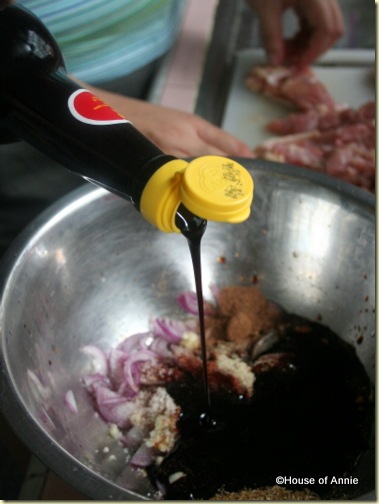
making marinade for indonesian satay

Basting ingredients:
1/4 cup kecap manis
1 tsp fish sauce
1 shallot, thinly sliced
juice from 1 calamansi (or 1/2 lime)
1 lemongrass pounded on the end to use as basting brush

Dipping sauce:
1 cup chunky peanut butter (or you could use ground up roasted peanuts)
1/2 cup water
1/4 cup palm sugar (about 1/3 of a block), chopped
1 clove garlic
2 shallots
1 tsp ground cumin
2 tsp ground coriander seeds
salt and freshly ground black pepper
1 tsp vegetable oil (peanut oil would be great!)
1 tsp fish sauce
as many bird’s eye chillies as you can handle, chopped
1/4 cup kecap manis, or more
3-4 calamansi juice or juice from 1 large lime

Method:
1. Marinate your meats in the marinade ingredients. If you’re worried that you won’t be able to tell which is chicken and which is pork, just separate into two bowls and pour marinade over both to cover.

Chicken in Indonesian Satay Marinade

chicken in indonesian satay marinade


2. Leave to marinate for at least 3 hours or overnight preferably.
3. Take marinated meat and skewer them on the bamboo skewers. Make sure to include fattier pieces with lean ones. And don’t overcrowd each skewer (that makes them harder to cook ie. more likely to burn on the grill!)

Indonesian Chicken and Pork Satay Skewers

Indonesian satay skewers

4. Once satay sticks are ready, prepare your grill. (Nate says: I used the bottom bowl and charcoal ring of my WSM, lit off some charcoal, and spread it out in an even layer.)
5. Prepare the basting ingredients and set your satay sticks on the grill. Baste with the basting sauce. (Nate says: the coals were so hot, the satay only needed to cook a few minutes per side before flipping. Next time, don’t use so much charcoal!)

Grilling Indonesian Chicken and Pork Satay

grilling Indonesian satay

6. For the dipping sauce: blend together first 9 ingredients (or if you’re like me, just pound them in a mortar) and transfer to a small pot. Set to boil and then simmer to incorporate all the flavors. Add chillies, kecap manis and calamansi or lime juice. Stir and taste. Adjust if necessary.

Once your satay meat is done, serve with the dipping sauce. Eat and repeat. Try to stop if you can.

Indonesian Chicken and Pork Satay
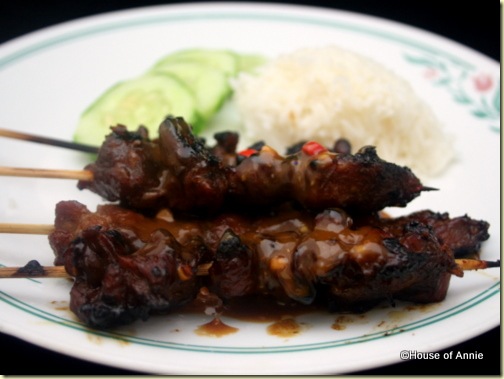
Indonesian Pork and Chicken Satay 2

Enjoy! Enjoy even more if you’re doing this by the beach in Hawaii ;-)

Cheers, Annie

What’s *your* favorite beach food memory? Leave us a comment and share your stories!

Hungry for more grilled food? Click below:

"Huli Chicken" recipe

Foodbuzz 24, 24, 24: Ultimate Rib Showdown, Part 1

Grilled Ribeyes on the WSM

Malaysian Chicken Wings: Two Ways

Killer Kalbi Recipe

Continue Reading: "Indonesian Chicken and Pork Satay (Sate Ayam dan Babi)"...