Please wait a few seconds while we redirect you
to the new and improved House of Annie website at
www.houseofannie.com !

Thursday, January 21, 2010

Tom Yam Fried Beehoon

Tom Yam Fried Beehoon

Elizabeth and I have been friends since high school. Our friendship was not the most immediate—she is naturally more suspicious and takes a long time to warm up to people. I, on the other hand, will talk to just about anyone who is near me. So the first time we met, I had come up to her to say hello and ask her name only to be met with a suspicious, “why do you want to know?” At least, this is what Elizabeth tells me. I don’t remember that at all. I only know that we’ve been good friends for a long time. We’ve been through years of sitting next to each other through high school, work (graduate school for me), and of course, FOOD.

Sharing Our Passion

For as long as I could remember, many afternoons after school, she would come back to my house and we would hang out for many hours (many times under the pretext of doing homework or studying for exams when in fact we would be watching videos, chit chatting or sneaking out of the house to go to the shops in the back to get snacks and drinks—we were teenagers and we were always hungry!).

These days, we both hardly meet because we live in different continents. But we are so thankful for the Internet for it has allowed us to continue our friendship through chats online. Every so often when we actually have free time that coincides, we will give each other a call. Many times, these calls will be filled with talk of foods and recipes that we’ve tried.

It’s really funny actually because growing up, we talked about food too BUT we never talked about cooking food, we only talked about EATING food—where to eat, what to eat, when to eat (often and sometimes immediately after we’ve eaten!). But we were no cooks—our cooking experience probably boiled down to cooking rice and instant noodles. We laugh now when we talk because we never imagined that the both of us would become so passionate about cooking.

So even though we haven’t physically met in many long years, we’ve stayed very much connected. She still is one of my closest friends. We’ve shared our lives—our struggles, our disappointments, our hopes, and our recipes. Whenever I tried a recipe that I really liked, I would always share it with her and she would do the same. You have all benefitted from this friendship as I’ve now shared several recipes that I got from her – Easy Green Tea Tiramisu, Hong Siew Braised Tofu, Khau Yoke - (with many more to come!).

Fit for a Family, Perfect for a Party

And this is how I got to know about this tom yam fried beehoon. Eliz was the one who first clued me in to it and told me I had to try it (it’s an Amy Beh recipe). And I have done so many times for many different occasions. This dish is really great for a weeknight meal. It’s also really great for a weekend party. It will serve a family or a whole group with equal ease and deliciousness. There is a slight amount of heat to this dish though, so the only ones I don’t recommend this to are younger children (my kids are starting to be able to handle the heat).

Beehoon (or rice vermicelli, maifan, mifun) is one of those noodles that I always keep handy in my pantry. They are an easy fix on days when you don’t know what to cook or when you have unexpected guests. With a few extra ingredients in your fridge, you could easily fry up some beehoon. As a matter of fact, here in Malaysia, they are used very frequently for breakfast. You will find them simply fried with some beansprouts and soy sauce and served with fried egg in many hawker stalls during breakfast time or if you’re in Kuching, you’ll find them in Sarawak Laksa (also a breakfast meal).

Bee Hoon – Rice Vermicelli

bee hoon, mi hoon, maifun, mifun

For me, I sometimes use beehoon when I’m cooking up my KL Hokkien Mee substituting the thick noodles for beehoon. They are really good that way. But this tom yam noodle dish is also really wonderful with beehoon. See, beehoon on its own is not very tasty. It’s really just a vehicle for the sauce that it soaks up. And this particular recipe has an especially flavorful sauce because of the addition of brown bean sauce and tom yam paste. The addition of the tom yam paste gives this noodles a discernible spicy tangy flavor (almost like Mee Siam, but not quite). The brown bean sauce counters these flavors with its salty sweetness. Add to that the other fillings and it’s a colorful, flavorful palate for your eyes and mouth.

Tom Yam Paste

tom yam paste

When we had our first official party at our house, I made this dish. I wanted to cook some things that were easy to do ahead of time. This tom yam beehoon is one of those. You just need to prep a few ingredients and the actual frying of it is very quick. A hot wok and some arm muscle and you’re good to go! Of course, if you’re cooking just for your family, the recipe as is will do (for the party I doubled the recipe).

Like many noodle dishes, the one tip I would give you is to make sure you prep all your ingredients and have them ready to go. Once you start frying the noodles, it is fast work and you won’t have time to chop something else up if you work while you cook.

Do give this noodles a try and let me know if you like it as much as Elizabeth and I!

Tom Yam Fried Beehoon Recipe

adapted from “At Home with Amy Beh” by Amy Beh

Ingredients:
200g beehoon (rice vermicelli), soaked in warm water for at least 15 minutes or longer, drained before cooking)
2-3 Tbsp vegetable oil
3 cloves garlic, minced
1 Tbsp brown bean sauce (tau cheong), if it’s whole beans, chopped or if using the ground one, fine as is
2 Tbsp tom yam paste (any brand is fine—available at most Asian grocery stores)
125g medium-sized shrimp, shelled and deveined
100g chicken meat (1 chicken breast), sliced thin (or you could use a cooked chicken breast, shredded)
1/4 tsp salt
1/2 tsp sugar
1/2 tsp sesame oil
1 block of firm tofu (taukwa), deep fried and sliced (I normally buy mine already fried but if you want, I’m sure it’ll taste just as good without frying)
100g garlic chives
100g beansprouts

Seasoning:
1 tsp fish sauce
1/4 tsp thick soy sauce
1/2 tsp sugar or to taste
dash of pepper
1/2 cup chicken stock

Garnishing (any or all of the below):
Fried egg omelette, thinly sliced
chopped cilantro
chopped green onions (about 2-3 stalks)
1 red pepper or jalapeno, sliced thin
fried shallots

*feel free to change about your fillings. No chives, throw in some green onions, no beansprouts, do without, no garnishes, no worries. It’s really not too fussy.

Method:
1. Season shrimp and chicken with salt, sugar, pepper and sesame oil for 10-15 minutes.
2. Heat oil on medium heat in a wok and fry garlic till fragrant but not burnt.

frying tom yam paste and garlic

3. Add chicken and shrimp and toss well till just opaque. Dish out and set aside.
4. Reheat wok on medium heat with more oil, put in brown bean sauce and tom yam paste. Stir it around for just half a minute being careful not to let the sauce burn. If there isn’t enough oil, add more. Add beehoon and stir in combined seasoning and mix well.
5. Add bean curd slices and return the fried shrimp and chicken to the pan. Add beansprouts and chives and toss to mix well.

tom yam fried bee hoon in wok

6. Taste and adjust seasonings.
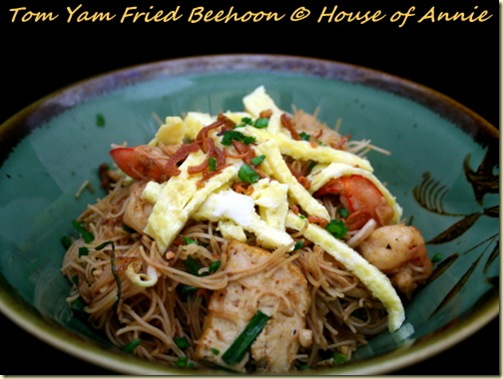
7. Plate up and garnish.

tom yam fried bee hoon

Enjoy!

Cheers, Annie

What’s your favorite way to eat beehoon? Leave a comment and tell us!

This post was entered into Presto Pasta Nights roundup #146, hosted by Cupcake Muffin.

Hungry for more Malaysian noodle dishes? Click below:

Grace Place Sarawak Laksa

KL-Style Hokkien Mee Recipe

Pumpkin Mee with Prawns Recipe

7 Tips for Making Mouth-Watering Char Koay Teow

Continue Reading: "Tom Yam Fried Beehoon"...

Tuesday, November 10, 2009

Homemade Pho Ga (Chicken Pho Noodle Soup)

Learn a few simple tips to make un-pho-gettable, pho-lavorful pho like a pro.

chicken pho

When I first moved to Hawaii, I discovered Vietnamese noodle soup - more specifically Pho. The first time I had it was in Honolulu’s Chinatown where a friend had recommended we go to this one restaurant that specialized in Pho. When we got there, there was a line out the door—a sure sign that the food was going to be good. And it was and my love affair with Pho started.

Un-pho-gettable

When we got to San Jose, I discovered that the Vietnamese population here was even bigger and we got exposed to so many more Vietnamese dishes. But even as I learned to love many other dishes, I had to have my pho every so often and every time I sat down to a bowl of Pho, that first sip of the broth would have me sighing contentedly. There was just something so heartwarming about the soup—the spices and herbs along with the hearty meat stock marrying together and creating a fragrance unlike anything else.

Even though beef pho is more common, Nate and I will sometimes order chicken pho (pho ga). The broth is often cleaner but with a more distinctive sweetness from using chicken stock, I suppose. Whatever it is, it is just as compelling as beef pho. We love them both equally. How about you? Which do you pre-pho?

Looking Pho-ward

Now that I’m in Malaysia, I find that Vietnamese food is not as popular here. I suppose that Malaysians have so many noodle dishes already that people are not as impressed by the subtleties of pho (or maybe they just aren’t aware of it). Our family misses this noodle soup quite a bit (Daniel and Esther gave a cheer when they heard I was making it). Thankfully, we brought most of the spices we would need to make it ourselves.

However, I have never made beef pho. Every so often, I have made chicken pho in California. That being the case, I decided that I would save the more daunting task of cooking beef pho for another occasion (it seems more daunting because beef stock is very unfamiliar to me). So today, I went to the market to get all that I needed for chicken pho.

The first thing I did was to make sure I got myself a really good chicken (I bought a free range chicken) and some extra chicken bones (I had saved some from previous cooks). Then I went looking for the fresh herbs and beansprouts that I would need for the garnishing. The noodles were an easy acquisition since pho noodles are very similar to kuay teow and I could find fresh ones at the market.

Everything else I already had at home in my pantry so I was set to go.

Can We Say Pho-lavor?

Before I first made pho, I heard from friends that making pho broth is a real production that takes days. But I learned how to make this dish from a student friend in my graduate student days. She made it look so simple, basically just boil some chicken with spices and aromatics that had been charred in a fire, add some seasonings, garnish with fresh herbs and dashes of lime and fish sauce. She alone convinced me that pho could be a simple meal and soon I was making it like a pro.

The one key thing that I learned from her was that the flavors in pho formed from the charring of the spices (cinnamon, black cardamom, cloves, star anise) and aromatics (ginger and onion). When we were in the dorm, we didn’t have access to a gas stove so we just broiled these ingredients in the oven till they had blackened in some parts. The charring lends the soup stock more depth and color.

Charring Onion and Ginger

roasting onion and ginger for pho

Once that is done, just put all the spices in a large stock pot and add the chicken and chicken bones. Fill with enough water to cover the chicken (about 15 cups). You want to have enough water at the start so that you don’t have to add water later which will then dilute the flavors. The stock is then simmered for a long time to extract the most flavor out of the chicken bones. You do want to take the whole chicken out midway (around 30-40 minutes) and cool it before removing the meat. The carcass is then tossed back into the stock to simmer some more.

As for seasonings, I find that you need to season quite strongly as the noodles themselves are very bland. I normally add salt and fish sauce and also a little bit of chicken bouillon. I also add some rock sugar into the stock to sweeten it up a little (I learned this from a former ESL student who was a cook at a popular pho restaurant in San Jose, and Andrea Nguyen also recommends it). When you taste it, it should be more strongly flavored than a normal soup. This will balance out once you add the noodles and beansprouts.

Pho-nishing Touches

The rest of the dish is really pretty simple. As the stock is simmering, just assemble the garnishes—beansprouts, Thai basil, sawtooth leaf herb, some jalapeno or other chilli peppers, and lime. Prepare the noodles—if you have dry ones, blanch in hot water quickly to soften, or if using fresh noodles, just give a quick rinse in cold water. Cut up the chicken meat into bite sized pieces.

One other trick that I have when serving I learned from observing the hawker stall vendors here that serve noodle soup. Ladle some hot soup into your assembled bowl of noodles and beansprouts and herbs, drain the soup back into the soup stock (which should be boiling hot by the way). Then ladle the soup back into the noodles again. This is to blanch and heat all the ingredients thoroughly and ensure that the soup itself is piping hot when served.

Finish by adding a squirt of lime and peppers to your taste. Serve hoisin and sriracha on the side if you like (I mainly use this as a dipping sauce for my meats but omitted it this time as the chicken was tasty enough without it)

Chicken pho (Pho Ga) recipe

serves 6-8

Ingredients:

1 whole free-range chicken (the better the chicken, the more superior the stock), about 1.5 kg (3-4lbs)
additional chicken bones (I used some chicken feet and neck and also an extra 2 whole rib bones)
2 large yellow onions, skin removed
3 inches ginger, skin removed
3-4 star anise
3-4 cloves
1 inch stick of cinnamon (thank you White on Rice couple for providing us with authentic Vietnamese cinnamon)
1-2 black cardamom pods, slightly pounded to allow flavors to be released
15 cups water
2 Tbsp salt
3 Tbsp fish sauce
1 inch chunk rock sugar
1 tsp chicken bouillon
1 tsp ground black pepper

Garnishes:
2 cups beansprouts (I err on the side of more in case some people like more sprouts in their bowl, whatever is leftover can be used in a stirfry or in making Vietnamese summer rolls later)
1 bunch Thai basil, washed
8 sawtooth herb leaves (optional)
2 limes, quartered
1 Jalapeno chilli, sliced
4-5 green onions, diced
Hoisin sauce and Sriracha sauce on the side

1 kg (about 2 lbs) fresh pho noodles (koay teow noodles) or a packet of dried rice noodles that have been softened in hot water

Method:
1. Char the onions and ginger over an open flame till they have dark brown bits all over. Do the same with the star anise, cloves, cinnamon, and cardamom (I just hold it with my tongs under the fire for a few seconds).

Charred Onion, Ginger, Cinnamon, Star Anise, Black Cardamom, Cloves

roasted aromatics for pho

2. Put the charred aromatics into a large pot with the chicken, chicken bones and water.

chicken and aromatics for pho

3. Bring to a boil. Skim off the scum that has risen to the top. Turn fire down to low and let simmer for about 2 1/2 to 3 hours.

skimming pho broth

4. About 30-40 minutes into the simmer, take out whole chicken and rinse in cold water to stop cooking. Drain and let it dry and cool. When cool enough to handle, remove wings, legs, thighs and cut off the breast meat. Return the rib carcass to the stock pot. Place the meats (uncut) on a platter and keep cool until needed.

boiled chicken

5. Clean and wash beansprouts, sawtooth leaf herb, and Thai basil. Prepare plate with the garnishes, green onions, lime wedges and chillies, if using.

Garnishes for Pho: Thai Basil, Bean Sprouts, Sawtooth Herb, Lime Wedges

Garnishes for Pho: Thai Basil, Bean Sprouts, Sawtooth Herb, Lime Wedges

6. Prepare noodles (wash with cold water if using fresh noodles, and soften dried noodles in hot water).
7. Slice chicken into bite sized pieces. Remove dark meat from bone.
8. When ready to eat, taste broth and adjust seasonings if needed. Remember that the stock should be strongly flavored (it should have a nice saltiness with an underlying sweetness). Put in freshly ground black pepper and bring stock back to a rolling boil.
9. Assemble bowl: place noodles, sprouts, herbs and chicken on the bowl. Ladle hot stock into bowl and then drain back into stock pot, without letting the other ingredients fall in (use a slotted spoon to hold them back). Re-ladle stock into soup bowl. Finish with a handful of green onions.
10. Squirt lime and add chillies to individual taste.

Pho Ga: Chicken Pho Noodle Soup

pho ga chicken pho

Go Pho It! (i.e. Enjoy)

Cheers, Annie

Since we used White on Rice Couple’s Vietnamese cinnamon in this dish, we are entering this post in Weekend Herb Blogging #209, hosted by Paul Chen’s Food Blog and administered by Cook Almost Anything.

Hungry for more noodles? Click below:

KL-Style Hokkien Mee Recipe

Pumpkin Mee with Prawns Recipe

Bun Rieu Cua

7 Tips for Making Mouth-Watering Char Koay Teow

Hokkien Prawn Mee

Continue Reading: "Homemade Pho Ga (Chicken Pho Noodle Soup)"...

Thursday, October 01, 2009

Grace Place Sarawak Laksa

First off, I want to say thank you to all our readers, who have been bearing with us while we get settled in to our new home in Kuching. Even though Annie has been cooking most nights of the week, there haven’t been too many House of Annie recipe posts lately. Most of our posts have been about goingout someplace to eat.

The main reason for this is, the big shipping crate carrying all our stuff (including kitchen appliances, all our normal herbs and spices, and the home computer with all our archived food pics on it) from San Jose hasn’t arrived yet. On top of that, the one tiny fluorescent lamp in our wet kitchen (where most of the cooking is done) has gone out, so it’s nearly impossible for me to get good pics of whatever Annie is prepping for dinner.

I never intended for this blog to be a restaurant review site. Most of you readers probably couldn’t fly here to Kuching to eat at the places we’re eating out at. That being said, I do want to tell you about a place we’ve found that serves some good Sarawak laksa.

Grace Place Sarawak Laksa

grace place sarawak laksa stutong kuching

What is Laksa?

According to Wikipedia, laksa is a spicy, soup noodle dish, originating from the merging of Chinese and Malay cultures (also known as Peranakan or Nyonya) which is found primarily in Singapore, Malaysia and Indonesia. Okay now, show of hands: How many of you know have tasted laksa? All right, now how many of you have tasted Sarawak laksa? That’s what I thought, very few.

Like me, most people are familiar with the curry laksa, a coconut-and-curry-based dish found in Singapore or KL. There’s also assam laksa, that sweet-spicy-sourish, fish-based dish found in Penang (I am absolutely in love with assam laksa from Penang!). But I didn’t know about Sarawak laksa until one day on maybe my second trip to Malaysia, when Annie’s cousin in KL took us to a stall in Bangsar that was known for its Sarawak laksa.

At first, I didn’t know if I’d like it. The broth was thin and brownish. There were a few prawns in it, plus shreds of chicken and strips of egg omelette. There was coconut in it, but no sharp curry flavor like curry laksa. Instead it was a mysterious but harmonious blend of spices, punctuated by a generous helping of fresh coriander. After first tasting it, and then finishing the entire bowl, I knew it was something I could enjoy again and again.

Looking for Laksa

When we first arrived in Kuching, we tried some Sarawak laksa from a stall near the hotel. It wasn’t very good – heavy on the white pepper, which covered up the nuances of flavor. Disappointing, but not daunting.

Later on, we moved into a house rented from a friend. We were cleaning up the place one day, when the friend brought over some lunch (what did I tell you about Kuching hospitality?). It was Sarawak laksa (of course, being already in Sarawak, they just call it laksa here).

This laksa was awfully good. I finished it all in no time, and was left longing for more. Our friend said that the laksa was made by a relative who owned a laksa stall. She gave us the location so we knew where to find the place.

Grace Place Sarawak Laksa Stall

grace place grace place sarawak laksa stutong kuching

One thing I have to note here. In Kuching, everybody eats early. This is especially true if you want to eat Sarawak laksa. The best laksa stalls are sold out by midmorning; after 10 am, you may either get the dregs, or you may get nothing.

So we were very fortunate when we recently showed up at 10:30 at the laksa stall, to find Aunty Rose still tending there. But as you can see, there wasn’t much soup left in her pot! She was literally scraping bottom to fill our order.

Grace Place Sarawak Laksa

grace place sarawak laksa stutong kuching

Aunty Rose put a lot of effort into making a quality laksa. Every day, she would wake up at 4:30am to heat up her soup. By 6:30, she would be at the stall, selling her laksa. She’ll finish at around 2 pm, then head home to start prepping the ingredients for the next day. By 8 pm, she’d be done prepping and off to rest before the next day comes and the cycle begins again.

I don’t think I could survive that kind of life. But Aunty Rose does it with calm grace, and a smile.

Aunty Rose’s Laksa

aunty rose sarawak laksa

Her laksa is thoroughly enjoyable from the first bite to the last slurp. Mix in a little homemade sambal belacan, add a squirt of kalamansi lime juice, and dig in. The thin rice vermicelli noodles still have a little crunch to them. The shredded chicken is flavorful in its own right. The bean sprouts, normally an afterthought, have their tips meticulously picked (another sign of the care she puts into her food).

And the broth? Oh the broth! Rich, savory, coconutty, with a pleasant chilli heat to it, it is slurp-alicious! This is not a broth to be left alone once you’re done eating the noodles. This is a broth that is good to the last drop. Next thing you know, it’s all gone.

You push back from your bowl with a sigh, face slightly sweaty, nose lightly runny, lips and throat tingly. You’re satisfied for now, but you know you want to come back for more.

Grace Place Sarawak Laksa

grace place sarawak laksa stutong kuching

Unfortunately, you can’t have any more. You see, as of the end of September, Aunty Rose has retired from her stall. (Notice the “Stall for Rent” banner in the pic below.) I literally got the very last bowl of Aunty Rose’s laksa!

grace place cafe stutong

I asked Aunty Rose what she is going to do in her retirement. She laughs. “I’m going to clean my house!” Too many years of dedication to the stall, and to her laksa, left her with little time to do anything else.

I say she deserves her break. Of course, it would be a shame to just let her recipe be lost, wouldn’t it? So we asked her if she would share it.

That’s right. We got her laksa recipe!

And we’re going to share it. Because you see, our shipping crate has arrived in Kuching and will be delivered shortly. We have a contractor who is coming to replace and upgrade the lighting in the kitchen. Soon, we’ll be posting recipes (including laksa!) once more.

Life is good!

Aloha, Nate

Don’t miss out on any of our recipes! Subscribe now to receive our latest posts to your RSS reader or to your Inbox.

Hungry for more Malaysian noodles? Click below:

KL-Style Hokkien Mee Recipe

Pumpkin Mee with Prawns Recipe

Hokkien Prawn Mee

7 Tips for Making Mouth-Watering Char Koay Teow

Continue Reading: "Grace Place Sarawak Laksa"...

Friday, October 17, 2008

KL-Style Hokkien Mee Recipe

This is the dinner I intended to make!

KL-Style Hokkien Mee

KL Hokkien Mee

Over a month ago, a bad batch of noodles ruined my last attempt at making KL (that's Kuala Lumpur, in case you didn't know)-Style Hokkien Mee.  Since my Mum is here visiting with us, we decided to make it again, this time verifying that the noodles were good.  Here is our successful attempt.

I need my noodles!

There are certain foods that I ate a lot of growing up. Noodles are one of them, in all their different styles. It’s the one thing I miss more than anything while living in San Jose. I have not yet been able to find really good noodles here. Some have been decent but none are as good as the ones I can find at home. It’s no wonder that when I get home, my eating wish-list always involves so many noodle dishes.

When I’m home in KL, there is one noodle dish that I truly enjoy (ok, maybe more like 3 or 4 noodle dishes but this one is top of the list). You know how in the past, I said I would not eat Char Koay Teow anywhere but in Penang. Well, this noodle dish I’m talking about today is one I won’t eat anywhere but in Kuala Lumpur. This is the dish that everyone equates with KL. Any true KL-ite will tell you that the dark, thickly coated, BLACK looking noodle dish, KL Hokkien Mee (not to be confused with Penang Hokkien Mee) is the one thing you have to try when you’re in KL.

I have discovered a fresh noodle that comes in a 2-lb package here in my Asian grocery store called “Taiwanese noodles” and it seems to work pretty well for this dish. What I like best about this particular noodle is that it doesn’t need blanching or boiling ahead therefore cutting my cook time by a lot and lessening my need to wash one more pot (very important when you have kids running around demanding your time).

Taiwanese Noodles

taiwanese noodles for fried hokkien mee

Other noodles you can use as a substitute are udon noodles, or thin rice noodles (beehoon). They all work just as well. Not as good as the real thing but hey, these are all my “make-do” recipes. You’ll just have to make a trip to Malaysia to taste the real thing someday.

Another important ingredient in this noodle dish is the dark and thick soy sauce. I have not been able to find a really good brand here and so the closest I have come to finding one that works is the Koon Chun Thick Soy Sauce which you should be able to find at the Asian grocery store. I love this sauce as you can use it for many different dishes. You will find me using this in my Char Koay Teow, Bah Kut Teh, chicken and pork dishes and marinades. So buy it and come back to look for different ways to put this sauce to use.

KL-Style Hokkien Mee

adapted from “Cook Malaysian”

Ingredients:

6 tbsp oil (lard is better if you have it)
8 cloves garlic, minced (about 5 tbsp)
2 tbsp thick soy sauce
2 tbsp soy sauce
1 tsp sugar
1 tsp salt
1 ½ cups water
½ tsp ground white pepper
6 oz pork tenderloin, sliced (chicken can be used too)
6 oz medium-sized shrimp, shelled and deveined
6 oz fishballs (cut in half), optional
1 (1/2 lb) bunch of mustard greens (yu choy) or cabbage, washed and cut into 1 ½ inch lengths

Method:

  1. Mix black soy sauce, soy sauce, sugar and salt with the water.
  2. Heat oil in a wok or large frying pan and brown the garlic.
  3. Add the pork and fry for a minute till it is slightly cooked, then add the fishballs and shrimp. Fry for another minute until shrimp is partially cooked.
  4. Add the soy sauce mixture and bring to boil.
  5. Add mustard greens and cover pan to wilt the vegetable.

    Pork, Fishballs, Shrimp and Veggies for KL-Style Hokkien Mee

    pork shrimp fishballs and bok choy for fried hokkien mee

  6. As soon as the greens have turned bright green, loosen noodles and add to the wok. Toss noodles around the sauce to coat noodles with sauce. Continue to turn noodles around until most of the sauce has been absorbed and noodles are looking dark and sauce has thickened. Add the white pepper and adjust seasonings.
  7. Serve with sambal belacan or sliced chillies.

KL-Style Hokkien Mee

KL Hokkien Mee

Now that's more like it!  It's still not as black or as thick as I I like it, but you can only do so much on an electric stovetop compared to a high-output gas burner.  Anyhow, we all really enjoyed this dish.

Cheers, Annie

If you liked this article, won't you consider Subscribing by Email to receive all our latest articles in your Inbox? From time to time, we will run giveaways on this site. As a verified email subscriber, you will be automatically entered in each drawing!

Hungry for more Malaysian noodle dishes? Click below!

Pumpkin Mee with Prawns Recipe

7 Tips for Making Mouth-Watering Char Koay Teow

Hokkien Prawn Mee

Hokkien Udon Mee from Babe in the  City

Kuala Lumpur Black Hokkien Mee from Lily's Wai Sek Hong

Continue Reading: "KL-Style Hokkien Mee Recipe"...

Friday, August 29, 2008

Pumpkin Mee with Prawns Recipe

Mum's Pumpkin Mee with Prawns

Mum's Pumpkin Mee with Prawns

When we were last back in Malaysia, Annie's mum cooked up her delicious Pumpkin Mee with Prawns. I made it a point to watch her cooking in the kitchen, taking notes on how she did it.

Mum's Pumpkin Mee with Prawns

Ingredients:

12 - 16 large shrimp, peeled and reserving shells
half a kabocha squash (about 1.5 lbs) *
6 cups water
4 cloves garlic, minced and fried crispy
1/3 cup dried shrimp (hay bee)
8 meatballs
8 fishballs
1-2 tsp chicken bouillon (to taste)
8 stalks of choy sum or yu choy
1 lb fresh egg noodles or yellow noodles
sesame oil

*If you can't find kabocha squash, use another hard squash like butternut squash.

Method:

  1. Peel and remove shells from the shrimp.
  2. Peel and chop the kabocha squash into 1 inch chunks.
  3. Boil the shrimp shells in a large pot of water to make broth, then remove the shells.
  4. Keeping the broth at a low boil, add the squash to the broth.
  5. Add the hay bee and half the fried garlic to the broth.
  6. Add the meatballs and the fish balls to the broth.
  7. Parboil the shrimp in the soup for a few minutes, then remove and set aside.
  8. Cook until the squash are fork tender.
  9. Add a bit of chicken bouillon and salt and pepper to taste.
  10. Add the chopped choy sum.
  11. Boil the egg noodles in the soup.
  12. Serve into individual bowls and top w/ the remaining fried garlic. Drizzle a little sesame oil on top for extra yumminess.

On one of our tries at making this recipe, we garnished with some chopped cilantro and fried shallots. We also served it with a little dollop of shrimp-chili paste.

Annie's Pumpkin Mee with Prawns

Annie's Pumpkin Mee with Prawns

This recipe is entered in the "Mee and My Malaysia" blog event hosted by Babe in the City-KL, celebrating Malaysia's "Merdeka" (Independence day). Selamat Hari Merdeka!

Aloha, Nate

Related Posts

Hokkien Prawn Mee

7 Tips for Making Mouth-Watering Char Koay Teow

Continue Reading: "Pumpkin Mee with Prawns Recipe"...

Thursday, July 24, 2008

7 Tips for Making Mouth-Watering Char Koay Teow

char koay teow plated


Even though I’m from Kuala Lumpur and lived there most of my life, I very seldom ate Char Koay Teow there. I’m pretty picky about my CKT. There is a simple reason for that: my dad hails from Penang. 'Nuff said!

Ok, I’ll elaborate for those not in the know. I’m sure there will be some who will challenge my opinion, but I really think that, outside of Penang, there are very few good Char Koay Teows to be had. When I was living in KL, it didn’t matter that I went many months without eating CKT because I knew that a trip to visit relatives in Penang was always on the horizon. I would soon be able to get my fix.

Sister's Char Koay Teow on McAlister Rd. in Penang


Sisters char koay teow Penang

Now that I am living in California, I miss eating Char Koay Teow quite a bit. So here is my “make-do” recipe for CKT while I am far away from the really good stuff. It's a decent recipe that I've added a few tweaks to so that the flavors stand out more.

Some tips that I have discovered along the way:


  1. Use a wok—a real wok, not one of those non-stick pans. If you must use a non-stick pan, it’ll still be ok, but won’t turn out as great.

  2. Use a gas stove. If you are stuck with an electric range like we are, improvise by getting a portable butane stove and cooking outside.

  3. Use lard. That's right, I said it. LARD. I save pork fat trimmings in the freezer and then cube them and render them for oil when I have enough to make about a cup's worth. I have sometimes substituted the lard by frying up some bacon and using the oil from the bacon (save the bacon bits for other applications like salads, soups, or just eating out of hand)

  4. Mise en place. Make sure you have all your ingredients in place before you start. Cooking Char Koay Teow is a very quick process.


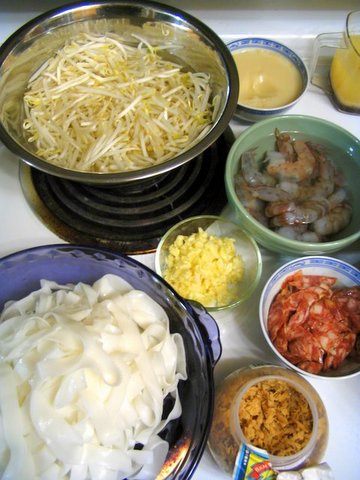
  5. Char Koay Teow ingredients: bean sprouts, lard, shrimp, garlic, Chinese sausage, preserved cabbage, and koay teow noodles


    char kway teow mise en place


  6. Use preserved cabbage for additional flavor. I think I got this idea from looking up a recipe for char koay kark which calls for it and I thought, hmm…why not for char koay teow also!

  7. Make single batches. Do not attempt to make a large batch of CKT. This dish works best when cooked individually. I never make this for a big party although I have been tempted to make this into a party activity where everyone fries their own.

  8. Watch your heat. If it’s too high, you can burn your dish easily. If not high enough, you won’t get that wok hei. The first attempt at cooking CKT will give you an idea of how you’re doing with the heat.


Alright, on to the recipe:


Char Koay Teow


feeds about 6 adults
Ingredients:
½ cup lard
1 head of garlic, minced
6 tsp preserved cabbage
½ lb of medium-large shrimp (I normally use 26-30 count and allocate about 3-4 per person)
2 chinese sausages (lup cheong), sliced thin on a bias
1.5 lbs of medium-width rice noodles, loosened. Here in San Jose, we can find them at the Asian grocery store, sold in trays, freshly made. If you really cannot find fresh noodles, I believe that dry pho noodles can be used as a substitute... but they just won’t taste as good.
6 eggs, or more if you like it more eggy
8 oz bag of bean sprouts
6 tsp Sriracha chili sauce (optional)
12 Tbsp CKT sauce (see recipe below)

(Some people like cockles in their CKT, but I don't. Others prefer crab meat. Tell me your favorite CKT ingredient!)

Method


Work quickly and in individual batches.
  1. Heat wok on high heat. When wok is very hot, add 2 Tbsp of lard. Toss in 1 Tbsp minced garlic, stir around and throw in 1 tsp preserved cabbage.

  2. Add 3-4 shrimp and stir it around till lightly pink. Toss in a small handful of Chinese sausage (about 6-7 slices or more).

  3. When shrimp is almost done, push shrimp to side of wok (where it’s less hot) and toss in a handful (about a loose cup) of noodles. Add about 2 Tbsp CKT sauce and chili sauce (up to how spicy you like it) to noodles and stir it around.

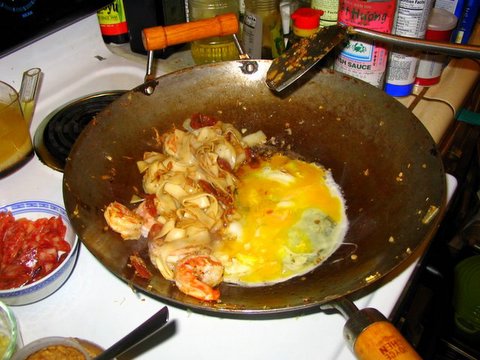
  4. Push noodles to side, and crack in one egg (or two). Scramble the egg a little and let it sit for half a minute untouched.

  5. frying char kway teow

  6. Add a large handful of beansprouts to noodles and stir everything together. As soon as beansprouts start to wilt a little, the dish is done and it’s time to plate up!


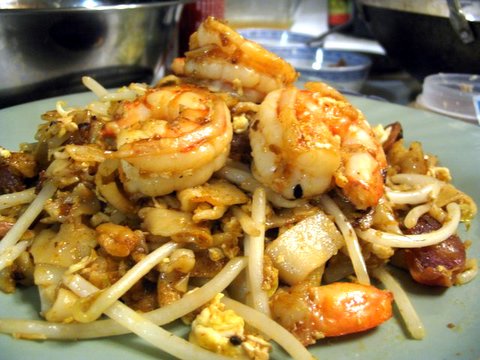
char kway teow plated


BONUS CHAR KOAY TEOW-MAKING TIP


If you’re a kind (read: sneaky) host, pass on the plated Char Koay Teow to someone else and continue cooking. Trust me, the best plate will be the last one (the wok will get more and more seasoned as you cook and the later dishes will take on a more smoky flavor).

Here's a video we made of the process. NOTE: This video was of the last batch being cooked, when we had barely enough koay teow noodles but a whole lot of bean sprouts!


See how quick that was? Eating it is just as quick, if not quicker.


Cheers, Annie

Sauce for Char Koay Teow


5 Tbsp soy sauce
1 Tbsp thick soy sauce
1-½ Tbsp oyster sauce
¼ tsp sugar
4-5 Tbsp water

Put all ingredients into a bowl and stir until the sugar and oyster sauce has dissolved into the other liquid ingredients.

Check out some of our other Malaysian recipes: Dhal, Hokkien Prawn Mee, Nasi Lemak, Rendang Chicken, Sambal Ikan Bilis

Like this recipe? Subscribe to House of Annie by email and never miss a new post!

More food porn

Continue Reading: "7 Tips for Making Mouth-Watering Char Koay Teow"...

Sunday, June 08, 2008

Bun Rieu Cua

Here's a tip for any would-be bloggers out there: never say you're going to blog about something "coming up next." You're just setting yourself up for serious trouble when Murphy strikes you with a serious case of writer's block.

It's been a month since I put in that darn scrolling marquee, proclaiming the soon-to-be posted memoir of our visit to Scott's Seafood. I thought it would motivate me to keep up with the regular posting. Instead it has been mocking me the whole time.

"C'mon already! What, can't even put two sentences together? Neener neener neener!"

Bleah. I've gotta get over this funk. And the only way to do it is just get posting again. So, I'm going to put the Scott's Seafood post on the back burner and pull something up to the front burner. A post that has been waiting just as long as the Scott's Seafood post to see the light of day, but at least hasn't been thumbing its nose and blowing raspberries at me.

Bun Rieu Cua


Bun rieu cua is a Vietnamese soup noodle dish that has a tomato and tamarind flavored broth with meatballs made from ground pork, crab meat and shrimp meat. This dish was taught to Annie by my sister, who got the recipe from her Vietnamese mother-in-law. It has become our favorite Vietnamese soup noodle dish to make at home, made more often then pho.

Meatball ingredients:

1 lb ground pork
1 lb shrimp, shelled and minced (reserve the shells)
1 bottle crab paste in bean oil
1 can bun rieu sauce
1 egg

Start by mixing up the meatballs. In this instance we used ground turkey as well as ground pork plus the minced shrimp. To that we added the jar of crab paste and the can of bun rieu sauce. Then we added in the egg and mixed well until combined. At this point, you can boil one meatball to taste (some brands of the crab paste are saltier than others). Adjust seasonings accordingly. _

*If you want the meatballs to be even more amazing, you can add a can of lump crabmeat to the mix.


Broth ingredients:

Shrimp shell broth
1 can chicken broth
3 cups water
1 28 oz can crushed tomatoes (or 8-10 chopped fresh tomatoes if you have them)
1 tbsp tamarind soup base mix (or to taste depending on how sour you like it)
3-4 stalks green onion, chopped
a few squirts of ketchup for color

Take the reserved shrimp shells and put them in a pot, then cover with water and bring to a simmer. Strain out the broth into a large stock pot.

To the stock pot, add the can of chicken broth , water, and tomatoes, and bring to a simmer. Form the meatball mixture into dumplings with a spoon and drop them into the stock. When they are cooked through, remove from the stock. Throw in green onions at the end. Add ketchup and tamarind soup base mix according to your taste and color preference.


Bowl ingredients:
1 pkg aburaage (deep fried tofu puffs)
1 pkg rice stick noodles (we use Jiangxi rice vermicelli noodles, or bun giang tay)
1/2 lb bean sprouts, washed
1 bunch purple shiso, leaves removed from the stems
1/4 head cabbage, shredded fine

Cut up the aburaage into bite-size pieces and and warm those up in the stock after the meatballs have been removed.

In another pot, boil some water and cook the rice stick noodles according to the instructions. Drain and set aside. Rinse the bean sprouts and shiso leaves and set aside. Finely shred the cabbage.

To assemble soup bowl, start with the noodles, then add some sprouts, shiso and cabbage. Ladle in some of the boiling hot soup until the veggies are covered, then pour the soup back into the pot. This will warm and wilt the veggies slightly.


Refill the bowl with soup and top with meatballs and aburaage. For an added, pungent kick, serve with a teaspoon of harm ha (Chinese salted shrimp paste).


For me, this is one of those perfect dishes that has all the flavors. The sweetness of the shrimp and crab, the saltiness of the harm ha, the sourness from the tamarind, the slight bitterness of the raw cabbage, and the umami of the tomato. The meatballs are heavy while the aburaage are light. The noodles are slippery, the bean sprouts are crunchy, and the shiso is...shiso-y.

Well, I hope this bun reiu cua recipe is worth the wait. One of these days, I may get to the Scott's Seafood post...but no promises!

Aloha.

Other homemade Vietnamese food: Pandan Waffles, Vietnamese Summer Rolls
Other soups using tomato: Turkey Tortilla Soup, Bouillabaisse, Pork, Eggplant, and Shiso Soup

Continue Reading: "Bun Rieu Cua"...

Saturday, November 17, 2007

Hokkien Prawn Mee

When you talk of Hokkien Mee, you have to qualify yourself: do you mean KL-style Hokkien Char Mee, or Penang-style Hokkien Prawn Mee? The two couldn't be more different. KL-style means thick, yellow noodles braised in a thick, dark soy sauce with pork, squid, fish cake and cabbage and, if you're lucky, some crispy pieces of lard. Enjoy it with some pickled chile peppers for a spicy-vinegary kick.

Penang-style Hokkien Prawn Mee is a soup-noodle dish, using both egg and rice noodles. The broth is made from lots and lots of prawns, plush pork and / or chicken bones. The noodles come laden with prawns, fish cake, pork, and crispy fried shallots.

Annie adapted this Hokkien Prawn Mee recipe off of the Rasa Malaysia website. She made a stock from shrimp shells and pork bones with some rock sugar for sweetness. Egg and rice noodles go on the bottom, followed by shrimps, pork, and a hard boiled egg. Ladle on the rich broth (great, unctuous mouth-feel with little bits of pork fat floating in it), then top with fried shallots. Serve with a spoonful of chili sauce made from blended chiles, shallots, garlic, and oil.


Our shrimp stock is not as dark as Rasa Malaysia's because we used mostly shells and not enough prawn heads. Next time, more heads!

Aloha.

Continue Reading: "Hokkien Prawn Mee"...

Saturday, September 29, 2007

Chee Cheong Fun with Unagi

A lot of times when we go out to dim sum, we order the cheong fun - steamed rice noodles filled with either shrimp or char siu. It's just one of those things we have to have, because you can't normally find fresh steamed noodles in the Asian groceries. The ones that are sold in the Asian groceries tend to be cold and hard and not as nice to eat.
Recently we found out that King Eggroll on Story Rd near McLaughlin in San Jose sells fresh steamed cheong fun. We bought a couple packets home, and they were quite soft! Cut the rolls up into chunks, then tossed them in a sauce consisting of hoi sin, soy sauce, dark soy sauce, water, and sesame oil. Garnished with cilantro (didn't have green onions) and sesame seeds.
We brought out a frozen unagi from the freezer and reheated it in the microwave to serve alongside the noodles.


Simple and tasty!

What would *you* do with noodles like these?

Aloha.

Continue Reading: "Chee Cheong Fun with Unagi"...

Tuesday, June 12, 2007

Miso Ramen

Annie found a packet of three servings of miso ramen at the Asian grocery, on sale for 3 bucks. These aren't your typical fried and dried "Top Ramen" type packets with the overly salty spice powder packet. The noodles are fresh and the sauce is a wet paste. The preparation is straightforward - boil water, make broth, pour over warmed noodles.

To the soup bowl, I added in some frozen corn sauteed in butter, blanched bean sprouts, a barely hard-boiled egg, some slices of home made char siu, and garnished with nori and chopped green onions. I added a few dashes of shichimi chili powder to mine to spice it up a bit.


This really hit the spot. It was just as good or even better than Ramen Halu in West San Jose (supposedly the best ramen in the South Bay).

Aloha.

Continue Reading: "Miso Ramen"...

Wednesday, March 14, 2007

Singapore Curry Laksa

Most of the Malaysian/Singaporean restaurants here in the Bay Area are not quite authentic because their chefs use local ingredients and adjust their recipes to suit local tastes. Here in San Jose, we're lucky to have a branch of the Singapore-based restaurant chain Prima Taste. Prima Taste ships all their sauces pre-made from Singapore, and so preserve the flavors.

We're also lucky that an Asian grocery near our place carries the Prima Taste brand of sauce and seasoning packets, for a pretty good price. This is their Singapore Curry Laksa.


You have to buy all the fresh ingredients - the noodles, bean sprouts, fish cake, shrimp, and egg. But to make the soup you just add the contents of the spice packet to water and bring to a boil, then assemble all the ingredients. In no time, you'll have a delicious bowl of fragrant laksa.

Aloha.

Continue Reading: "Singapore Curry Laksa"...

Saturday, March 10, 2007

Won Ton Char Siu Loh Mein

When Annie makes won tons, it's no small matter. She makes enough to feed an army -- and have leftovers to feed them another night!

Ground pork mixed with minced shrimp, garlic, ginger, onion, green onion, water chestnut. Seasoned with salt, pepper, soy sauce, chicken bouillon, and sesame oil. The package of won ton wraps contains about 90 skins.


Filled and folded.


Making use of the last of the char siu.


Aloha.

Continue Reading: "Won Ton Char Siu Loh Mein"...

Char Siu Loh Mein

Here in San Jose we have some restaurants and delis that make good char siu. But with char siu marinades available at the Asian groceries, you can now make it at home without too much fuss.

We marinated some "country-style" pork ribs in char siu marinade for 2 days, then grilled them until cooked through.


One of the easiest applications is to just thinly slice the pork and serve it atop won ton noodles with blanched baby bok choy, a la char siu loh men.


The next few posts will be highlighting what else we did with the char siu.

Aloha.

Continue Reading: "Char Siu Loh Mein"...

Friday, January 26, 2007

Pad Woon Sen

This Thai dish features bean thread vermicelli noodles, shrimp, fresh shiitake mushrooms, wood ear fungus, minced pork, bean sprouts, and fried eggs. Garnished with a little chopped cilantro and fresh squeezed lime juice. Healthy and delicious!


Aloha,

Nate.

Continue Reading: "Pad Woon Sen"...

Bun Rieu

This is a Vietnamese soup noodle dish that features a shrimp, tomato, and tamarind flavored broth, pork meatballs with spiced minced crab meat and minced shrimp, tofu, rice noodles, and shiso leaves. Annie makes this about every 6 months, and the huge pot never lasts more than two days. It is intensely flavored, and savored to the last drop!


Aloha,

Nate.

UPDATED Bun Rieu Recipe here

Continue Reading: "Bun Rieu"...

Thursday, November 30, 2006

Homemade Char Kway Teow

Annie was feeling like some homemade (as in Malaysia) char kway teow. "Kway teow" is a steamed , flat rice noodle. "Char" is to fry.

For the ingredients, we have bacon fat, bean sprouts, prawns, chopped garlic, lup cheong (Chinese sausage), the kway teow, and preserved vegetables.


Melt some bacon fat in a hot wok, then toss in a couple of spoonfuls of garlic and preserved vegetables. Stir until fragrant, then add some lup cheong and a few prawns. Stir-fry until the prawns start to turn pink. then add the noodles. Season with a sauce made from soy sauce, dark soy sauce, oyster sauce, salt, sugar, white pepper, and chili sauce. Stir it all together for about a minute.

Push the noodles off to one side, add a little more bacon fat, and crack an egg. Break it up and let it start to firm up.


Stir the noodles back into the egg and mix it well to break the egg up. Toss in a handful of bean sprouts. Fry for another minute or two, then plate up.


This version is missing some green onion but that's okay.

What is really missing is the "wok hei" of a well seasoned wok. We use our wok for everything, from frying to steaming fish to braising Filipino adobo to simmering grated pineapple. It never gets a chance to build up all those nice, fried food nuances. We need a wok just for stir-frying...and a gas burner to go with it.

Aloha,

Nate

Continue Reading: "Homemade Char Kway Teow"...